
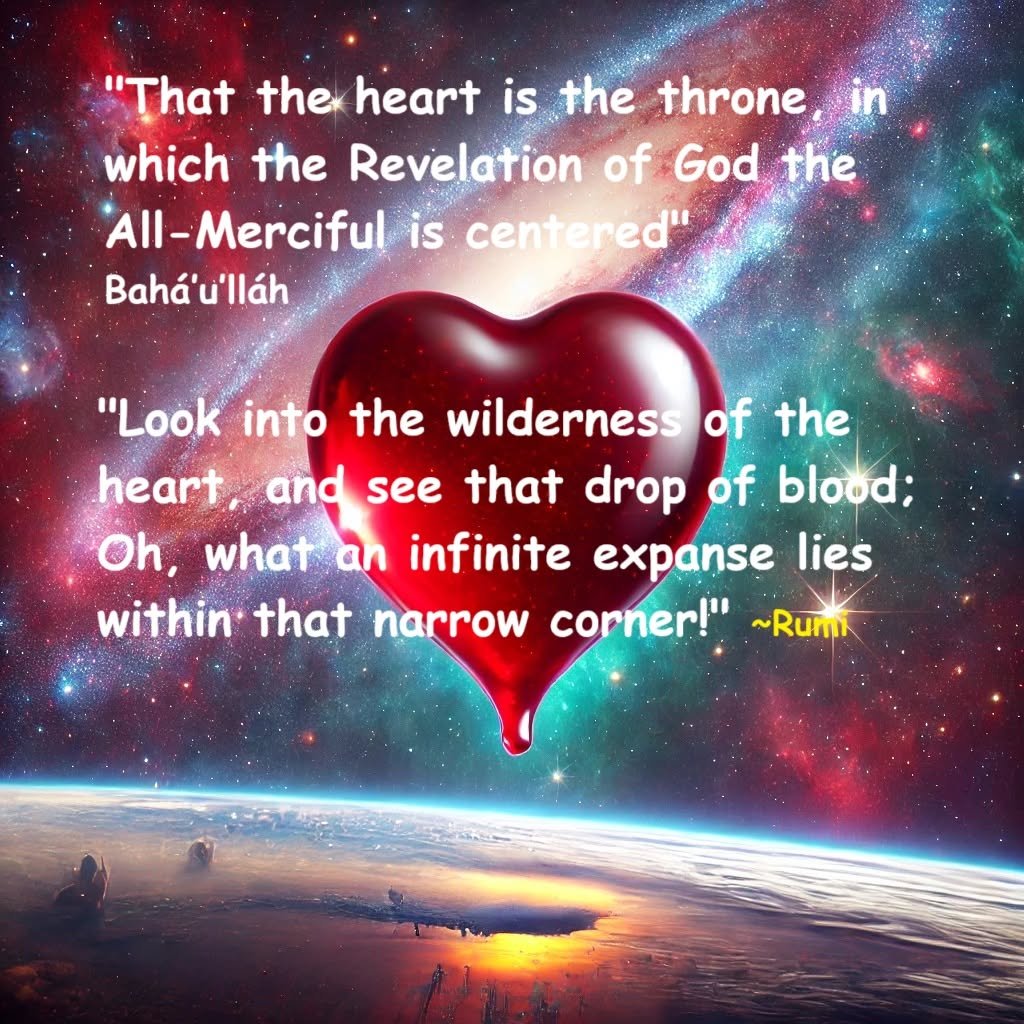
Love came and flowed through my veins and skin like blood;
It emptied me of myself and filled me with the Friend.
Every particle of my being was claimed by the Beloved;
Of me, only a name remains—everything else is He.
In mystical thought, love is regarded as the most powerful force that moves human beings toward perfection. Great mystics and poets such as Jalāl al-Dīn Muhammad Rūmī (Molana), Hafez of Shiraz, and Farid al-Din Attar of Nishapur viewed love as a bridge between humanity and divine reality. In their understanding, the more the human heart is filled with love, compassion, kindness, and remembrance of God, the more the veils of heedlessness are lifted and the light of spiritual knowledge shines within. Thus, mysticism is a journey from the self toward God, and from outward appearances to the inner truth of existence, with the ultimate aim of attaining peace, unity, and nearness to the Divine.
How blessed is the joyful bird that found its station in love;
For on Mount Qaf, no creature but the Simurgh finds its true abode.
In the mystical tradition of Iran and the spiritual heritage of the East, the heart is not merely a physical organ responsible for circulation and life. Rather, it is considered the center of spiritual perception, the seat of divine love, and the place where heavenly mysteries are revealed. Mystics maintain that while the human mind reasons and analyzes, it is the heart that perceives truth. For this reason, the heart is regarded as the dwelling place of love, and love as the pathway to mysticism. These three realities—the heart, love, and mysticism—are like interconnected links in a single chain; without one, the others cannot fully realize their meaning.
Love was the soul’s unrest and longing;
To think of one’s own life before Love was a disgrace.
Before Love, both head and soul were insignificant
To anyone intoxicated with this sacred wine.
The lover strikes at the very heart of the battle,
Standing firm in the ranks where the war is fiercest.
Never does he cast a glance toward escape,
Even if a hundred thousand swords are drawn against him.
Love is the meadow where lions roam;
How could a dog ever become the lion of that field?
Love carries countless souls hidden within its sleeve;
Upon the path of Love, to offer one’s life is but a sacrifice.
Name and reputation, modesty and calculation,
Before Love’s broom are nothing but dust.
Affliction hunts down all people,
But for the lovers, affliction itself becomes the prey.
So willingly do they embrace suffering with their very souls,
That even suffering itself is left ashamed before them.
In the Bahá’í Faith, the heart occupies an exalted station and is regarded as the center of spiritual perception and the recipient of divine grace. Bahá’u’lláh likens the human heart to a mirror which, if cleansed of the rust of selfishness, prejudice, and material attachments, is capable of reflecting the light of God. The Bahá’í writings place great emphasis on purity of heart, sincerity, love, and attentiveness to God, for a pure heart is the repository of divine attributes and the source of spiritual peace and assurance. From this perspective, human spiritual growth depends less upon the accumulation of knowledge and more upon the transformation of the heart and the refinement of one’s conduct and actions.
Love desires that this truth be brought forth into the open;
For how could a mirror fail to be clear and polished?
Do you know why your mirror is not clear and shining?
Because the rust has not yet been removed from its face.
Or, as Rumi says elsewhere:
Rust upon rust has gathered over your heart,
Until it has grown blind to the hidden mysteries.
Bahá’u’lláh, in The Hidden Words, describes the human heart as the dwelling place of God and the “seat of the revelation of His beauty and glory.” He writes:
“O Son of Dust! All that is in heaven and earth I have ordained for thee, except the human heart, which I have made the habitation of My beauty and glory; yet thou didst give My home and dwelling to another than Me. And whenever the manifestation of My holiness sought His own abode, He found therein a stranger, and, homeless, hastened unto the sanctuary of the Beloved. Yet I have concealed thy secret and desired not thy shame.”
— The Hidden Words, Persian No. 27
In this same sacred dwelling, God has kindled a candle by the hand of His power and asks us not to extinguish it through the opposing winds of selfish desire and passion. Bahá’u’lláh writes:
“O Son of Dust! The candle of thine heart is lighted by the hand of My power; quench it not with the contrary winds of self and passion. The healer of all thine ills is remembrance of Me—forget it not. Make My love thy treasure and cherish it even as thy very sight and life.”
— The Hidden Words, Persian No. 32
Mysticism is a profound and inward knowledge of the reality of existence and of humanity’s relationship with God, transcending outward learning and rational argument. In the mystical path, individuals strive to attain divine knowledge by purifying the heart of selfishness, material attachments, and undesirable qualities. Mystics believe that truth cannot be fully grasped through study and intellectual reflection alone; rather, it must be perceived through the heart and experienced spiritually. Thus, mysticism is a path of spiritual journeying and wayfaring toward nearness to God through love, worship, service, and the purification of the self.
In the gathering of lovers, there is a different kind of repose;
And the intoxication of this wine of love is of another kind.
The knowledge acquired in the school is one thing,
But love is another matter altogether.
The Bahá’í Faith embraces mysticism, yet it distinguishes it from isolation, ascetic withdrawal, and separation from society. In the Bahá’í writings, true mysticism is inseparably linked with the knowledge of God, purification of the self, divine love, and service to humanity. A person is called not only to cleanse and transform the inner self, but also to manifest this spiritual insight and love in daily life through service to others. For this reason, the spiritual journey in the Bahá’í Faith is accompanied by social responsibility, and spiritual perfection finds expression in love for all people and in striving for the unity of humankind.
Bahá’u’lláh states:
“Today, true humanity is found in those who arise to serve all the peoples of the earth.” The Blessed Beauty declares: “Blessed is he who ariseth to serve the nations.” And in another passage He states: “The earth is but one country, and mankind its citizens. Glory is not his who loves his own country, but glory is his who loves the whole world.”
— Gleanings from the Writings of Bahá’u’lláh
https://www.bahai.org/r/738298040
This statement demonstrates that service to humanity is not merely a social obligation; rather, it is a hallmark of true human nobility and a pathway to the attainment of spiritual perfection. In the Bahá’í perspective, love of God finds its highest expression in love for all people and in selfless service to the human family. Since the whole world is regarded as one homeland and all people as its citizens, devotion to the well-being of humanity becomes both a spiritual responsibility and an essential expression of the mystical journey toward God.
‘Abdu’l-Bahá likewise regards work and effort undertaken in service to others as an act of worship. He states:
“Every effort and exertion put forth by man from the fullness of his heart is worship, if it is prompted by the highest motives and the will to do service to humanity.”
— Paris Talks, pp. 176–177
According to this perspective, spiritual life is not separate from social life. Rather, work, education, raising children, participating in the building of society, and serving one’s fellow human beings all acquire a spiritual and devotional character when they are performed with pure intentions and inspired by divine love. In this light, everyday life itself becomes an arena for worship, where ordinary acts are transformed into expressions of faith through selfless service and dedication to the well-being of others.
‘Abdu’l-Bahá further states:
“He laid the foundation of the unity of the world of humanity… He regarded the whole human race as one family.”
And, quoting Bahá’u’lláh, He says:
“O people of the world! Ye are all the fruits of one tree and the leaves of one branch.”
— The Promulgation of Universal Peace, p. 169
Therefore, in Bahá’í mysticism, love for God cannot be separated from love for His creatures. A heart filled with divine love cannot remain indifferent to the suffering and needs of others. Spiritual perfection is manifested when one’s love for God finds expression through service, justice, unity, and efforts to promote the well-being and oneness of humankind. Thus, mysticism in the Bahá’í Faith is not a path of withdrawal from the world, but rather a path toward building a better world through the transformation of the heart and service to humanity.
Mystics likewise regard the heart as a mirror which, if cleansed of the rust of selfishness, prejudice, and worldly attachments, can reflect the light of truth. Rumi says:
When the mirror of the heart becomes clear and pure,
You will behold images beyond water and clay.
You will see both the image and the Painter,
The carpet of sovereignty and the One who spreads it.
From this perspective, the heart is an instrument of knowledge that transcends the intellect. The intellect may point out the path, but it is the heart that leads the human being to the destination. For this reason, many mystics have distinguished between outward knowledge and inner, heart-centered understanding. In their view, true knowledge is the fruit of inward experience and spiritual insight, rather than merely the result of study and rational argument.
Beyond the veil of blood, Love has its rose gardens;
Lovers have dealings with the incomparable Beauty of Love.
Reason says, “The six directions are your limit; beyond them there is no way.”
Love replies, “There is indeed a path—I have traveled it many times.”
Reason glimpsed a marketplace and began to trade;
Love beheld, beyond that marketplace, countless other bazaars.
How many Mansurs *, hidden through their trust in Love’s very soul,
Forsook the pulpits and ascended the gallows.
Within the lovers who drink the wine of suffering dwell delights untold;
Within the dark-hearted rationalists abide only denials.
Reason says, “Set not your foot there, for in annihilation there are nothing but thorns.”
Love answers Reason, “Those thorns are within you.”
Be silent now! Uproot the thorn of selfhood from the foot of your heart,
And you shall behold rose gardens blooming within your own being.
O Shams of Tabriz, you are the sun concealed behind the clouds of words;
When your sun rises, all speech fades into nothingness.
Love, too, in mysticism is the force that awakens the heart. In its mystical sense, love is not merely an emotional attachment between two human beings; rather, it is the soul’s attraction toward absolute perfection and the infinite beauty of the Divine. Mystics believe that God created human beings with the capacity for love, and that this love must ultimately return to its original source—God Himself. Rumi regarded love as the driving force of the universe and taught that it cannot be learned in the classroom or acquired through formal scholarship.
Love is not found in learning, knowledge, books, or written pages;
All the talk and discourse of people is not the path of the lovers.
Know that the branches of Love are rooted in eternity past,
And the roots of Love extend into eternity to come;
This tree depends neither on the celestial Throne nor upon the dust of earth for its support.
We have set aside the rule of reason and restrained the desires of the self,
For such majesty and grandeur are not suited to this limited intellect and these human traits.
From the mystical perspective, love liberates the human being from the limitations of the ego and selfishness. When the flame of love is kindled in the heart, a person gradually detaches from material attachments and moves toward a higher reality. Love removes the veils that obscure truth and prepares the heart to receive the divine light.
In the Bahá’í teachings, love is regarded as a divine force and the very foundation of creation. Love for God and love for humanity are seen as two expressions of the same reality. ‘Abdu’l-Bahá teaches that love is the cause of the life of the human world, the source of the unity of hearts, and the foundation of peace and oneness. From this perspective, love is not merely a personal emotion but a creative power that inspires human beings to service, self-sacrifice, justice, and compassion toward others. The more divine love increases within the human heart, the more spiritual qualities such as kindness, forgiveness, humility, and service to humanity become manifest.
In the Bahá’í teachings, love for God and love for humanity are inseparable. Love of God must find expression in human conduct and in service to others. Friendship, compassion, forgiveness, assisting those in need, overcoming prejudices, and striving for the unity of humankind are practical manifestations of this love. Thus, in the Bahá’í Faith, love is not a fleeting sentiment but a transformative and constructive force that guides both the individual and society toward peace, justice, and unity.
Therefore, love in the Bahá’í teachings serves as a bridge between humanity and God, and also between one human being and another. When the human heart is illumined by divine love, the boundaries of race, nationality, class, and religion lose their significance, and all people are seen as members of one family. Such love forms the foundation of a new civilization and the realization of the ideal of the oneness of humankind.
“Love is greater than peace, and peace is one of the fruits of love. Until love is attained, true peace is impossible; and true peace is among the results of love—especially the love of God, which is the chief purpose of human life. This is spiritual progress in the world of religion.”
— Second Address of ‘Abdu’l-Bahá at the Church of the Ascension, New York, June 3, 1912
Mysticism, in reality, is the path of this transformation. It is an inward journey from self to God and from multiplicity to unity. This journey begins in the heart, continues through love, and culminates in spiritual knowledge and union. Along this path, the mystic learns to move from self-centeredness to God-centeredness, and from attachment to spiritual freedom. Love is the force of movement, and the heart is the instrument of perception and receptivity.
In the writings of many Persian mystics, such as Rumi, Attar, Hafez, and Sana’i, the heart occupies a central place. Hafez writes:
“At the dawn of eternity, the radiance of Thy beauty shone forth in revelation;
Love appeared and set the whole world aflame.”
In this verse, love is portrayed as the consequence of the manifestation of divine beauty—a beauty first reflected in the human heart. A heart prepared to receive this revelation becomes connected to the source of love and discovers the path of mysticism.
One of the most significant characteristics of the heart in mysticism is its capacity for transformation and expansion. The more love and affection increase within the heart, the greater becomes a person’s capacity to perceive truth. For this reason, mystics have consistently emphasized purity of heart, service to humanity, forgiveness, and kindness. They believe that love for creation is a bridge leading to love for the Creator. A heart filled with love and compassion becomes prepared to receive divine inspirations and spiritual insights.
Thus, in the Bahá’í Faith, the heart, love, and mysticism are three inseparable realities. The heart is the receptacle of divine light, love is the driving force of spiritual growth, and mysticism is the path of knowing and drawing nearer to God. When the human heart is illumined by divine love and that love finds expression in service to others, mysticism transcends the boundaries of an individual experience and becomes a force for the transformation of both the person and society.
In conclusion, without the heart, love loses its meaning; and without love, mysticism becomes a collection of dry and lifeless concepts. Authentic mysticism is a path that begins with the awakening of the heart, continues through the fire of love, and culminates in the knowledge of and nearness to God. Whenever the human heart is filled with divine love, the way of mysticism is opened, and life itself takes on a new dimension of meaning, peace, and spiritual radiance.
Conclusion
An examination of the concepts of the heart, love, and mysticism in the light of the Bahá’í teachings and the rich heritage of Persian mystical literature reveals that these three realities are inseparably intertwined, together charting the path of humanity’s spiritual ascent. The heart is the gateway to spiritual perception and the seat of divine illumination; love is the life-giving force that moves the human being from self-centeredness toward God-centeredness and service to others; and mysticism is the conscious experience of this inner journey and its expression in practical life. Great Persian poets and writers such as Rumi, Hafez, Attar, Sana’i, and Sa’di have, through centuries of poetry and wisdom, portrayed the heart as the mirror of truth, love as the mystery of creation, and mysticism as the path leading to the Eternal Beloved, thereby enriching Persian culture with these profound spiritual concepts. While honoring this precious legacy, the Bahá’í Faith offers a new dimension to it by demonstrating that true mysticism is not confined to solitude and individual experience, but reaches its fulfillment through love for all people, service to humanity, and efforts to realize the unity of humankind. Thus, a heart illumined by divine love guides the individual toward a dynamic and responsible mysticism—one whose fruits are not only personal peace and spiritual growth, but also active participation in building a world founded upon love, justice, peace, and unity.
*Mansur al-Hallaj (c. 858–922 CE) was one of the most celebrated and controversial mystics in the history of Islamic spirituality. Born in Persia, he became renowned for his passionate devotion to God and his bold expressions of mystical experience. Hallaj is best known for his famous declaration, “Ana al-Haqq” (“I am the Truth”), a phrase interpreted by many mystics as an expression of the annihilation of the ego in the overwhelming presence of the Divine, rather than a claim to personal divinity. His teachings emphasized divine love, self-sacrifice, and the soul’s longing for union with God. Accused of heresy by religious and political authorities of his time, he was imprisoned for many years and eventually executed in Baghdad in 922 CE. Despite his tragic fate, Mansur al-Hallaj became a symbol of spiritual courage and the transformative power of love, inspiring generations of poets and mystics, including Rumi, Attar, and Hafez, who regarded him as the archetype of the lover willing to sacrifice everything in the path of the Beloved.