
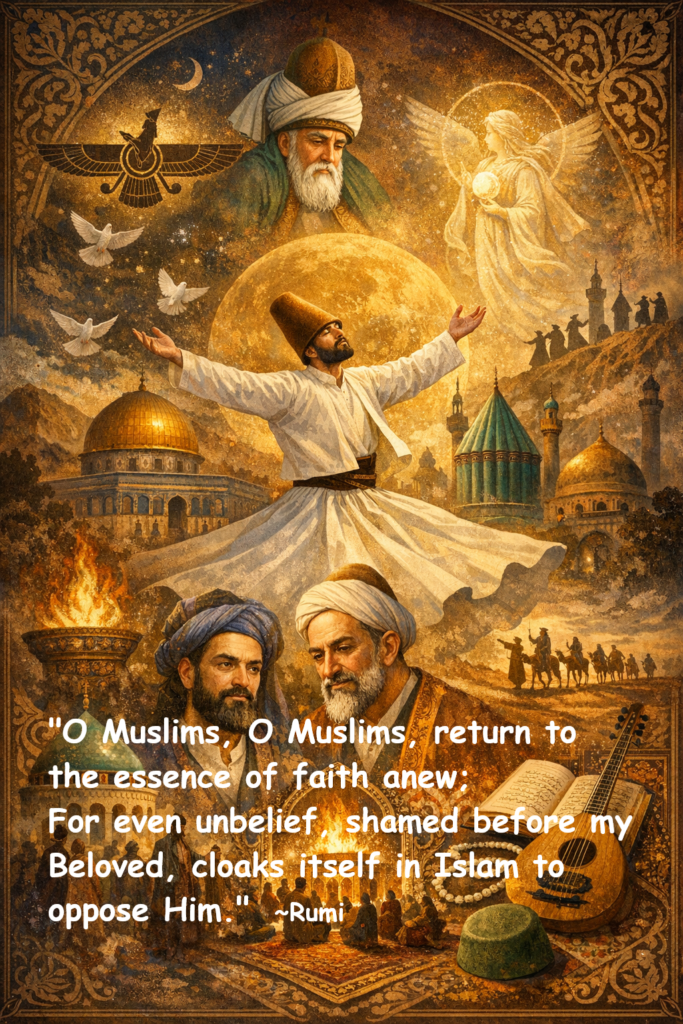
The roots of Sufi movement
Etymology
The conventional view is that the term “Sufi” originates from suf, the Arabic word for wool, referring to the simple cloaks that early ascetics wore. Another possible etymology traces the root to safa, meaning “purity,” placing the emphasis on purity of heart and soul. A third suggestion links it to “Ashab al-Suffa” — the “Companions of the Veranda” — a group of Muslims during the Prophet’s time who devoted themselves to prayer on the veranda of his mosque. A fourth etymology, advanced by Al-Biruni, connects it to the Greek word Sophia, meaning wisdom. New World Encyclopedia
Islamic Roots (The Dominant View)
It is now largely established that the movement grew out of early Islamic asceticism, developing as a counterweight to the increasing worldliness of the expanding Muslim community; only later were compatible foreign elements adopted and made to conform to Islam. Encyclopedia Britannica
This mystic tradition within Islam developed in several stages — first emerging as early asceticism based on the teachings of Hasan al-Basri, then entering a stage of classical mysticism of divine love promoted by al-Ghazali and Attar of Nishapur, and finally emerging in the institutionalized form of today’s network of fraternal Sufi orders, associated with figures such as Rumi and Yunus Emre. Wikipedia
Sufis themselves trace the origin of the movement to the Prophet Muhammad, believing there were two dimensions to the revelations he received — one in the form of the words of the Qur’an, and another as divine inspiration within his heart, meant to be conveyed “from heart to heart” to the chosen few. Islamandpeace
The Umayyad Reaction
Sufism emerged early in Islamic history partly as a reaction against the expansion of the early Umayyad Caliphate Wikipedia, whose growing wealth and political ambition troubled those who sought a more inward, spiritually pure path.
Broader and Pre-Islamic Influences
The origins of Sufism remain a subject of scholarly discussion, but many historians agree that while Sufism formally emerged within early Islamic civilization during the first centuries after Islam, its mystical character was deeply influenced by older spiritual traditions present in lands such as Persia. Mainstream scholarship describes Sufism as the mystical dimension of Islam that developed in the early Islamic period, especially as a reaction against excessive materialism and political worldliness in the Umayyad era. However, when Islam expanded into Persia, it encountered an ancient civilization already rich in metaphysical thought, symbolic spirituality, and mystical philosophy, including traditions rooted in Zoroastrianism and broader Persian mysticism. Many scholars acknowledge that Persian spiritual culture significantly contributed to shaping the language, symbolism, and philosophical depth of later Sufi thought.
Ancient Iran long possessed a profound mystical heritage before the rise of Islam. Zoroastrian teachings emphasized the soul’s purification, the cosmic struggle between light and darkness, and the spiritual ascent of humanity toward divine truth. Persian mythology and philosophy also contained symbolic narratives of divine love, illumination, and union with the heavenly realm. These ancient Iranian concepts created fertile intellectual ground upon which Islamic mysticism later flourished. While Sufism itself is generally not considered older than Islam by academic consensus, many researchers argue that Persian converts infused Islamic spirituality with their own pre-Islamic mystical worldview, enriching Sufism with themes of divine love, ecstatic longing, and illumination.
Iran soon became one of the greatest centers of Sufi thought and literature, to the extent that Persia is often described as the cradle of classical Sufism’s literary and philosophical flowering. Indeed, many of the most celebrated Sufi masters and poets—including Rumi, Attar, and Hafez—were Persian and composed primarily in the Persian language. Persian Sufi literature flourished especially between the 12th and 15th centuries and became one of the most influential spiritual literary traditions in world history. Through poetry and prose, Persian Sufis transformed abstract theological ideas into deeply emotional and symbolic expressions of the soul’s yearning for union with the Divine.
Because of this Persian dominance, many people view Sufism not merely as an Islamic movement but as the continuation of the ancient Iranian mystical spirit clothed in Islamic terminology. Although such a claim goes beyond strict academic consensus, there is little doubt that Persian culture gave Sufism much of its artistic beauty, philosophical sophistication, and universal appeal. Without the contributions of Iranian thinkers and poets, Sufism would likely not have reached the poetic and spiritual heights for which it is known today. Thus, while Sufism historically arose in the Islamic era, its heart and soul were profoundly shaped and elevated by the mystical heritage of Persia.
The Emergence of Formal Orders (Tariqas)
The regular Sufi orders began to be established only in the 11th and 12th centuries. The first great order was the Qadiri order, founded by Shaykh Abdul Qadir Jilani (1071–1166), followed by the Suhrawardi order and later the Naqshbandi order of Khwaja Baha’ ud-Din Naqshbandi (1318–1389). Islamandpeace
Almost all traditional Sufi orders trace their “chains of transmission” back to the Prophet via his cousin and son-in-law Ali ibn Abi Talib, with the notable exception of the Naqshbandi order, which traces its origin to Caliph Abu Bakr. New World Encyclopedia
The Persian dimension is, of course, central to all of this — the great Sufi poets writing in Persian (Rumi, Hafez, Attar, Sa’di) gave the movement much of its literary and philosophical depth, carrying its ideas far beyond the Arabic-speaking world.
The characteristic of Sufi’s movements.
- Inward Mystical Focus
Sufism represents the inward-looking, mystical dimension of Islam. It is better understood not as a separate sect, but as an approach that mixes mainstream religious observances — such as prescribed daily prayers — with a range of supplementary spiritual practices like the ritual chanting of God’s attributes (dhikr) or the veneration of saints. Pew Research Center
Where Sharia provides the legal code of the faith, Sufism focuses on the emotions that drive humanity toward connecting with the divine: compassion, love, and patience. Smithsonian
- The Pursuit of Fana — Union with God
Sufism developed religious practices focusing on strict self-control that enable both psychological and mystical insights as well as a loss of self, with the ultimate goal of mystical union with God. Patheos
Practitioners engage in spiritual exercises including self-mortification, zikr (remembrance of God), sama (musical recitals), and Fana-o-Baqa — dissolution of self for union with God — to induce mystical states of ecstasy. Drishti IAS
- Organized Orders — the Tariqa
The term tariqa is used for a school or order of Sufism, particularly for the mystical teaching and spiritual practices of such an order with the aim of seeking haqiqah (ultimate truth). A tariqa has a murshid (guide) who plays the role of leader or spiritual director. The members or followers are known as murīdīn, meaning “desirous” — those desiring the knowledge and love of God. Wikipedia
Sufis organized themselves into communities centered around khanqahs (hospices or lodges), led by a master (shaikh or pir), and formed spiritual lineages (silsilas) that linked disciples back to the Prophet Muhammad. Drishti IAS
- Asceticism and Self-Purification
The ultimate aim of Sufis is to seek the pleasure of God by endeavoring to return to their original state of purity and natural disposition, known as fitra. Wikipedia
Sufis have traditionally taken vows of poverty and celibacy. The movement may have been named for the coarse wool garments they wore as a mark of their rejection of worldly things. Patheos
- Poetry, Music, and Sacred Arts
Sufis are known for their use of poetry and music in their practices, with famous poets like Rumi and Hafez articulating their spiritual experiences through lyrical expressions. Fiveable
During Sama, a spiritual ceremony of music, song, and dance, Sufi music provides a space for the soul to experience closeness with divinity and love. The style and syncopation of Sufi music vary because they reflect a community’s uniqueness, yet the purpose of the Sama remains the same across cultures. Smithsonian
- The Pir-Disciple Relationship
The Pir offers wisdom, teachings, and guidance to help disciples achieve spiritual growth and understanding, often leading them through the stages of Sufi practice and experience. Next IAS This master-disciple bond is considered essential — spiritual knowledge is transmitted from heart to heart, not merely through texts.
- Veneration of Saints and Dargahs
Dargahs, the shrines built over the graves of Sufi saints, are both spiritual centres and hubs of social and cultural interaction. They attract followers from all faiths and social backgrounds, offering a space where people can come together for prayer, meditation, music, and charity, and where the poor and needy can seek aid. Next IAS
- Inclusivity, Egalitarianism, and Interfaith Harmony
One of the Sufi movement’s most significant contributions was promoting communal harmony between religious communities. Sufi saints emphasized inclusive spiritual practices that transcended religious divisions, focusing on universal values such as love and devotion. Next IAS
The Sufi movement played a crucial role in the upliftment of marginalized communities — including women, lower castes, and the poor — preaching a message of equality and universal brotherhood, emphasizing that all human beings, regardless of social standing, are equal in God’s eyes. Next IAS
- Peaceful Spread of Faith
The Sufi movement played a crucial role in spreading Islam through peaceful means, often emphasizing love and devotion rather than rigid adherence to legalistic interpretations. Rather than relying on military conquest or strict legalism, Sufi practitioners engaged with local populations through community-building, spiritual guidance, and cultural exchanges. Fiveable
- Tension with Orthodox Islam
While Islam traditionally emphasizes adherence to Sharia (Islamic law), Sufism diverges by focusing on the esoteric and spiritual aspects of the faith. Sufis rejected the idea that rigid rituals were necessary for spiritual progress and instead taught that true devotion and connection with God came from within. Next IAS
Rumi asks us to view Islam through a new lens:
O Muslims, O Muslims, reclaim your true Islam from its source;
For even disbelief, ashamed before my Beloved, comes clothed in Islam to oppose Him.
For only the name of Islam and Muslimhood remains, while its true meaning has become empty:
He whose heart was a hundred miles inclined toward faith,
Becomes weary when he sees people like you;
For he sees only the name, but not its meaning—
Just as one may call a barren desert a “meadow.”
Where love exists, neither disbelief nor faith remains:
Know with certainty: the lover is no Muslim;
In the religion of love there is neither disbelief nor faith.
In love there is no body, no intellect, no heart, no soul;
Whoever has not become thus, is not of it.
These characteristics explain why Sufism has endured for more than twelve centuries, and why figures such as Rumi continue to inspire all humanity.
The Masnavi-ye Ma’navi of Rumi is perhaps the most complete literary manifestation of these Sufi qualities:
The Masnavi, which is the polish of souls,
Its return shall be the day of victory.
The dawn of this passion and profit in history
Was in the year six hundred and sixty-two.
These characteristics together explain why Sufism has endured for over twelve centuries and why figures like Rumi — whose poetry you know so deeply — remain universally resonant. His Masnavi, which widely influenced mystical thought and literature throughout the Muslim world, Britannica is perhaps the fullest expression of these Sufi characteristics in literary form.
Sufi exists in old Percian cultures.
The Mystical Soul of Ancient Persia: Precursors to Sufism
The Central Thesis: Continuity of the Persian Spirit
Persian mysticism, or the Persian love tradition, is a traditional interpretation of existence, life, and love, reliant upon revelatory and heart-felt principles in reasoning. Though partially sourced from the mystical Zoroastrian traditions of the Persian Empire, in its contemporary practical aspects it is now synonymous with Sufism in contemporary Iran. Wikipedia
The thread is unbroken. What the ancient Persians called Asha — truth, righteousness, cosmic order — and what the Sufi masters later called Haqiqah — ultimate divine truth — are, at their deepest level, expressions of the same eternal Persian spiritual hunger: the soul’s longing to reunite with the Source of all light.
- Zoroastrianism: The Oldest Root
The Spiritual Architecture of Ancient Persia
By 650 BCE, the Zoroastrian faith, a monotheistic religion founded on the ideas of the philosopher Zoroaster, had become the official religion of ancient Persia. LOC It was far more than a religion in the conventional sense — it was a complete cosmological, ethical, and mystical worldview that shaped Persian identity for over a thousand years before Islam arrived.
Zoroaster proclaimed that Ahura Mazda was the supreme creator and sustaining force of the universe, working through the Amesha Spenta — seven divine entities representing aspects of the universe and the highest moral good. Central to this was Asha (‘truth’, ‘cosmic order’), the principle of righteousness promoted and embodied by Ahura Mazda, standing in opposition to Druj (‘falsehood’, ‘deceit’). Wikipedia
This cosmic tension — between truth and falsehood, light and darkness, purity and corruption — is precisely the internal spiritual battleground that Sufi mujahada (spiritual striving) would later inhabit. The Sufi war against the nafs (the lower self) is Zoroastrianism’s war against Ahriman turned inward.
Asha and Sufi Ethics: The Same Flame
The Zoroastrian concept of Asha — truth, order, righteousness — continued in the Islamic idea of Adab, meaning proper conduct, etiquette, and spiritual discipline. Persian literature, such as Sa’di’s Gulistan and Rumi’s Masnavi, emphasized justice, humility, and cosmic balance — hallmarks of Zoroastrian ethical thought. Efiretemple
When Rumi writes of burning away the self in the fire of love, he is drawing on a vocabulary — fire as divine light, purification through ordeal — that Zoroastrian Persia had cultivated for a thousand years before him.
The Mystical Dimension Within Zoroastrianism
Even within Zoroastrianism there must have existed an esoteric teaching. Many of the profoundest themes concerning man’s quest after the Divine are repeated throughout the history of this land with almost the same language, in such a manner as to remind us of the eternal nature of both the mystical quest and the Persian spirit. PhilArchive
Zoroastrianism, especially in its later Sassanian and Manichaean forms, cultivated a mystical path where the soul ascended through light, purity, and knowledge. This gave rise to celestial hierarchies of angels and lights, reminiscent of Zoroastrian angelology, and the belief in hidden knowledge (batin) accessible only to the purified heart — themes that would become central to Persian Sufism. Efiretemple
- Mithraism: The Religion of Divine Light and Brotherhood
One of the most overlooked precursors to Sufi mysticism is Mithraism, the ancient Persian religion centered on the god Mithra — the deity of light, truth, covenants, and cosmic justice. Mithraic initiates formed brotherhoods, underwent graduated spiritual trials, shared sacred meals, and sought union with the divine light. The structural parallels to Sufi tariqas — with their orders, initiations, masters, and disciples — are striking. As one scholar in the comparative tradition notes, many jewels of Mithraic thought can be found in distorted ways among the Sufis. Blogger
The Sufi image of the tavern of love — where the divine wine is shared among initiates who have passed beyond ordinary consciousness — carries clear echoes of Mithraic sacred feasting. And the central Sufi symbol of fire as divine love finds its most ancient expression in the sacred fires of Mithraic and Zoroastrian temples.
III. Manichaean Light Mysticism
Mani (216–276 CE), the Persian prophet who founded Manichaeism, offered another powerful mystical stream that flowed into what would become Sufism. Mani taught that the human soul is a particle of divine light imprisoned in matter, and that the spiritual life consists of freeing that light through knowledge, purity, and ascetic discipline. This doctrine — the soul as divine spark longing to return to its origin — resonates profoundly with the Sufi concept of fana (annihilation of the self) and baqa (subsistence in God).
Sufism grew slowly into a theosophical system by adopting traditions of Neoplatonism, the Hellenistic world, Gnosticism — an ancient esoteric religio-philosophical movement that viewed matter as evil and spirit as good — and spiritual currents from Iran and various countries of the ancient world. Encyclopedia Britannica Manichaeism was one of the most potent of those Iranian currents.
- The Ishraq Philosophy: Where Persia and Sufism Meet Most Explicitly
The most direct bridge between ancient Persian mysticism and Islamic Sufism was built by the great Persian philosopher Suhrawardi (1154–1191 CE), founder of the Ishraq or Illuminationist school of philosophy.
To Suhrawardi is attributed the philosophy of ishraq (“illumination”), and he claimed to unite the Persian (Zoroastrian) and Egyptian (Hermetic) traditions. His didactic and doctrinal works taught a complicated angelology; some of his smaller Persian treatises depict the journey of the soul across the cosmos, where the “Orient” (East) is the world of pure lights and archangels. Encyclopedia Britannica
Suhrawardi explicitly and consciously drew on Zoroastrian cosmology — its hierarchy of lights, its divine beings, its concept of Khvarenah (divine glory or radiance) — and wove them into an Islamic Sufi framework. He was, in this sense, the scholar who made visible what had always been present: that Persian Sufism and ancient Persian spirituality were one continuous tradition wearing different garments.
- Poetry as the Eternal Persian Spiritual Language
Perhaps the most profound continuity between ancient Persia and Sufism is the use of poetry as the primary vehicle of divine truth. The Gathas — the oldest texts of Zoroastrianism, attributed to Zoroaster himself — include a collection of hymns and one of the oldest examples of religious poetry in human history. LOC
This is not coincidental. The Persian soul has always expressed its deepest spiritual truths through poetry rather than dry theology — through image, metaphor, and music rather than legal code. Persian poets used Islamic forms — ghazals, qasidas — to express pre-Islamic mystical yearnings. Persian Islamic texts integrated Zoroastrian ideas of cosmic struggle, soul testing, and divine guidance into mainstream Islamic discourse. Efiretemple
When Hafez writes of the tavern, the wine, and the Beloved, he is simultaneously inside and outside Islam — drawing on a Persian spiritual vocabulary far older than the Qur’an, while honoring the Qur’an’s inner light. This dual citizenship is the hallmark of the Persian mystical tradition from Zoroaster to Rumi to Bahá’u’lláh.
- The Persian Transformation of Islam Itself
When Arab armies swept across Persia in the 7th century, they brought with them a new faith. But over time, something unexpected happened: the conquered transformed the conquerors. The Persians did not simply adopt Islam — they infused it with their own philosophical, spiritual, artistic, and administrative traditions. Islam in Persia was not merely a religion imposed from outside — it became a luminous continuation of Persian spiritual genius. Zoroastrianism did not vanish; it transfigured — its ethics, cosmology, and culture woven into the very fabric of Islamic civilization. Efiretemple
Persian mysticism finds its roots in the ancient Zoroastrian traditions that shaped early Iranian spirituality. With the advent of Islam in the 7th century, mystical elements from this new faith began to intertwine with pre-existing beliefs, giving rise to a unique blend of spiritual philosophy. This syncretism laid the groundwork for a rich mystical tradition characterized by a deep exploration of the self and the divine. Untold Persia
Islamic Extremism and How Sufism Can Save Islam from Within
Part One: Understanding Islamic Extremism
What Is Islamic Extremism?
Islamic extremism is a subset of the broader phenomenon of Islamism, influenced by global Islamic revivalist thought. It has developed on the basis of Islamic fundamentalism and is the result of the radicalization of that fundamentalism. Islamic extremist groups generally aspire to establish a purely “Islamic State,” replacing modern legislation with Sharia law and challenging contemporary nation-state regimes through either peaceful protests or violent confrontations. Springer
At its ideological core, Islamist extremism carries an absolutely divided and antagonistic worldview of the “Us” — the “true Muslim” in-group who must strive to live in an “Islamic State” — versus “Them,” the non-Muslim and “wrong Muslim” out-groups who are stripped of their human status due to their opposition to what extremists define as “true Islam.” Springer
This binary, exclusionary logic is precisely the opposite of the Sufi worldview, which has always embraced the full spectrum of humanity.
Historical Roots of Extremism
The seeds of modern Islamic extremism trace most directly to Wahhabism, a puritanical movement born in 18th-century Arabia. The current wave of Islamic extremism has its roots in an ideology known as Wahhabism. Al-Qaeda, Salafis, the Taliban, and other radical groups have set off suicide bombs and killed innocent civilians to make political statements. In Iraq, Pakistan, and other places, these groups have killed those they consider opposition — especially Sufis and moderate Shias, who are traditionally peace-loving Muslims. New Age Islam
Historically, Wahhabi and similar puritanical movements have been in direct and hostile opposition to Sufism. Seventeenth-century puritanical reformers like the Kadızadelis were determined rivals of Sufism and popular religion. They condemned what they considered non-Islamic innovations and passionately supported reviving the beliefs and practices of the earliest Muslim generation. Wikipedia This impulse — to strip Islam of its rich cultural, mystical, and artistic heritage and reduce it to a rigid set of literalist rules — is the same impulse that drives modern extremist movements.
Three Models in the Muslim World Today
A noted Pakistani anthropologist offers a helpful framework. There are three distinct models in play in the Muslim world: modernism, which reflects globalization, materialism, and a consumer society; the literalists, who are reacting, sometimes violently, against the West and globalization; and the Sufis, who reject the search for power and wealth in favor of a more spiritual path. Christian Science Monitor The average Muslim today, caught between these forces, is in genuine turmoil — and the path they choose will shape the future of the faith.
Part Two: Why Sufism Is Islam’s Most Powerful Antidote
The Spiritual versus the Literal
“In the Islamic world, Sufism is the most powerful antidote to the religious radicalism called fundamentalism, as well as the most important source for responding to the challenges posed by modernism,” says Seyyed Hossein Nasr, professor of Islamic Studies at George Washington University. “Sufism has kept alive the inner quality of ethics and spiritual virtues, rather than a rigid morality… and it provides access to knowledge of the divine reality.” Christian Science Monitor
The fundamental distinction is this: extremism operates from the outside in — imposing law, compliance, and coercion. Sufism operates from the inside out — transforming the heart, which then transforms behavior.
The prevention of the contemporary wave of Islamist extremism requires a response that does not end with mere enforcement laws. In many instances, the problem persists or even thrives despite ever stricter enforcement. This is because the problem affects hearts, emotions, and beliefs. What is necessary is the rehabilitation of the hearts and souls of individuals affected by extreme thoughts and feelings of hatred. Increased attention should be given to the role of spiritual values and morals emphasized in the Islamic tradition as a viable remedy. Eurasia Review
The Conspicuous Absence of Sufis from Violence
If we scan the landscape of the Islamic world, we can notice one continuing pattern: in all the violence and terrorism in the world, practicing Sufis are conspicuously absent. This is a sufficient justification to encourage Sufism and sponsor Sufi institutions. New Age Islam
This is not coincidental. The Sufi path — with its emphasis on self-purification, love, and the dissolution of the ego — is structurally incompatible with the hatred, tribalism, and self-righteousness that fuel violent extremism.
Universalism and Inclusivity as the Counterforce
Sufism should rightly be considered a possible antidote to religious extremism and violence, primarily due to the values of universalism, inclusiveness, and compassion that are heavily emphasized in Sufi philosophy — values which form the tenets of Islamic teachings and are at direct variance with the actions of violent extremists. Eurasia Review
Rumi’s poetry is perhaps the most eloquent expression of this universalism ever written. His call — “Come, come, whoever you are” — extends to humanity without condition, without exclusion, without a litmus test of creed. This stands as a direct refutation of the extremist impulse to define ever-smaller circles of the “true” believer.
Purification of the Heart as Prevention
One may argue that the study of Sufism should precede the study of other disciplines in Islamic religious knowledge. Islam not only places a high value on knowledge, but is also concerned with the manner — the adab — in which that knowledge is acquired. If the proper adab of learning as prescribed by Sufi scholars is not adhered to, there may come situations whereby the knowledge gained is distorted, manipulated, or leads students astray. This is precisely what Sufism can offer to the modern world. Eurasia Review
Extremism, at its root, is a distortion of knowledge that entered an “unclean vessel.” Sufi training addresses this by insisting that the vessel — the human heart — be purified before it is filled.
Music, Poetry, and Culture as Instruments of Peace
In the ongoing debates over how to respond to extremist Islamism, too little attention has gone to the vast and deep repertoire of Sufi philosophy, rituals, and artistic production, which accompanied the most enlightened centuries of Muslim civilization. The Washington Institute
The classical Persian poetic tradition — Rumi, Hafez, Sa’di, Attar — is not merely literature. It is a living spiritual curriculum that has drawn millions toward beauty, love, and God rather than toward hatred and destruction. As Jonathan Granoff, former member of the United Nations’ NGO Committee on Disarmament, said at the 2016 World Sufi Forum: “The entire world, East and West, needs to rethink and reform its existing strategy on countering jihadist terror. Sufism is an inspiring antidote which awakens the human capacity for love, service, compassion, and peace.” Brookings
Part Three: The Practical Work of Sufism Against Extremism
On the Ground: Education and Community
In Morocco, Sufi cultural associations are described as a “front line in the battle against Islamist extremism,” where young people are taught to chant poetry about the Prophet and to find spiritual nourishment in the arts, rather than in the sermons of radical imams. As one Sufi leader observed: every young person attracted to the Sufi path is one less attending a Wahhabi imam’s sermon preaching incitement. The Washington Institute
Morocco’s Minister of Islamic Affairs belongs to a Sufi order, as does the rector of Zaytouna University in Tunis, the sheikh of al-Azhar in Egypt, and prominent anti-Wahhabi scholars based in Saudi Arabia itself. The Washington Institute Sufi leadership is thus embedded at the highest levels of Islamic institutional life.
Soft Power and Diplomatic Recognition
Since the beginning of the global war on terror, Sufism has come to be seen as a gentle, moderate alternative and a tool of counterterrorism policies in many Muslim-majority countries. As a popular instrument of “religious soft power” and “positive branding of Islam,” Sufism has been used by state and non-state actors to influence what others do through attraction and persuasion rather than coercion. Brookings
Spreading Islam’s Historical, Tolerant Self
Traditional or historical Islam is not recognizable in Wahhabi rigidities. It is instead found in the rich and varied cultural, intellectual, and aesthetic experiences of Muslims stretching back fourteen hundred years — in the calligraphy and woodwork of ancient cities, in the Andalusian melodies of Sufi gatherings. The revitalization of Sufism’s inward-looking religious consciousness is seen as an antidote to the coercive religious ideology embodied in Wahhabism and other extremist strains of Islamist thought. The Washington Institute
Conclusion: The Heart Is the Battlefield
The crisis of Islamic extremism is, at its deepest level, a crisis of the heart — a crisis of meaning, love, and identity. Extremism offers the false comfort of certainty, of rigid belonging, of an enemy to blame. Sufism offers something far more demanding and far more transforming: the path inward, toward God, toward love, toward the dissolution of the ego that generates hatred in the first place.
Rumi wrote: “Out beyond ideas of wrongdoing and rightdoing, there is a field. I’ll meet you there.” That field — where the human soul encounters the divine without the intermediary of coercion or violence — is precisely what Sufism has always cultivated, and what Islam most urgently needs to reclaim today.
The Bahá’í tradition, which grew from the same Persian mystical soil, shares this conviction: that the transformation of civilization begins with the transformation of the individual soul. Together, these streams of thought point toward the same truth — that no political or military force can defeat an ideology of hate as effectively as a living, breathing culture of love.