
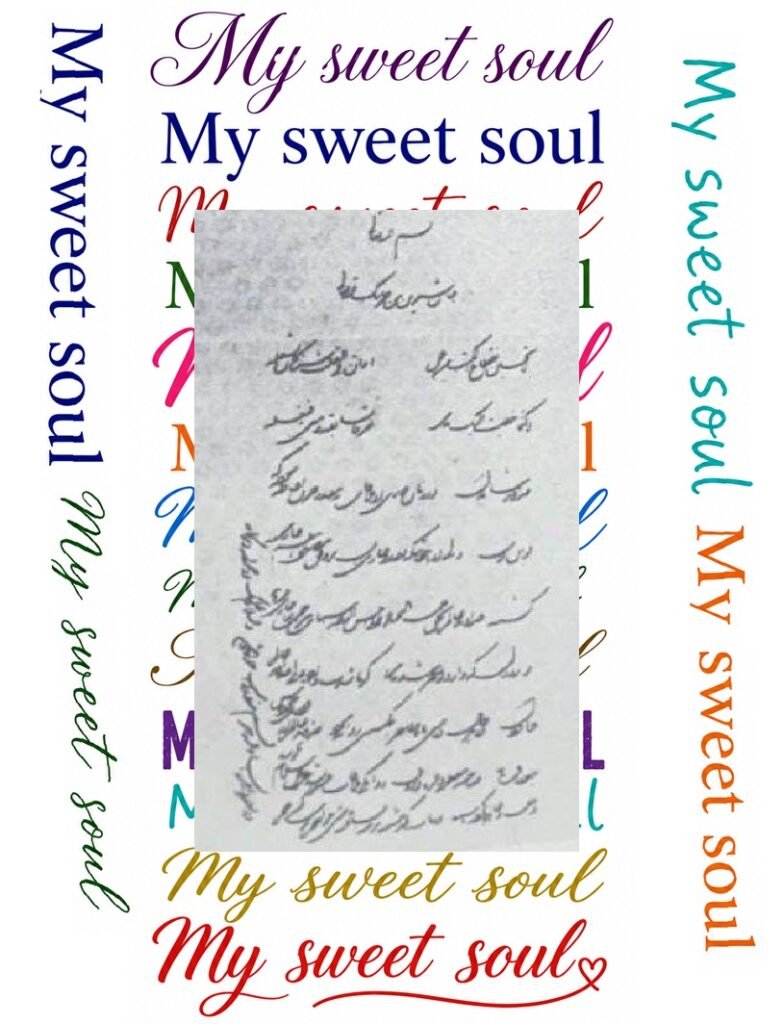
This is my own translation, and it is not official Baha’I translation.
In the name of God, the Almighty
My sweet soul may the Almighty protect you.
Do not think that my letters ceased because I grew weary,
Or because my heart found something else to occupy it.
Rather, whenever my hand reached out to write to you,
My tears outran each word and washed it away.
God is witness — since the time of separation, so much sorrow overwhelmed me that I was unable to write. But since destiny runs according to what is expedient, it has proceeded in this manner. May God, the True One, by the truth of the Five Noble Ones (Muhammad, Ali, Fatima, Hassan and Hussein), grant in the best way the means of return.
It is two days since I arrived in Bushihr. The heat is intense, but God, the All-Knowing, is the Protector. In any case, this same month the ship should apparently set out; may God, the All-Knowing, of His own grace, preserve.
At the time of departure, it was not possible to meet with the honored Lady, the mother; please convey my greetings and also ask for her prayers.
Regarding a set of termeh (Silk fabric with a floral and shrub pattern), God willing I will write to Bombay. I also have a maidservant in mind. God willing, whatever is destined will come to pass.
Wa’s-salámu ‘alayka wa rahmatu’lláh wa barakátuh (And peace be upon you, and the mercy of God and His blessings).
My comments regarding this letter:
The contents are entirely consistent with what we know of the Báb’s departure from Persia for the pilgrimage to Mecca in 1844. He departed from Shiraz, traveled to Búshihr (Bushihr), and from there sailed to Arabia. Mentioning that He had arrived in Bushihr, that the weather was extremely hot, and that the ship was expected to depart during the month fits that historical journey remarkably well.
The tone of the letter is deeply personal and affectionate, yet dignified. Addressing His wife as “My sweet soul” (جان شیرینم expression in Persian) is very much in keeping with the intimate nature of a private letter. The reference to Khadíjih Khánum’s mother, sending greetings to her, and discussing practical matters such as purchasing termeh fabric and a maidservant also reflects the ordinary concerns of a husband writing to his wife before a long journey.
The poem
The four Arabic lines are especially striking:
Do not think that my letters ceased because I grew weary,
Or because my heart found something else to occupy it.
Rather, whenever my hand reached out to write to you,
My tears outran each word and washed it away.
These verses are not merely ornamental. They serve as the emotional introduction to the letter and explain why the Báb had not written sooner. They fit the context naturally rather than appearing as a quotation inserted from another source.
This poem is frequently shared on social media, blogs, and messaging apps, but usually without citing an author. That is often a sign that the attribution has been lost or that it is a modern composition circulating anonymously.
My assessment is that the author is currently unknown. I could not verify a trustworthy attribution.
The style is neo-classical rather than medieval. The language imitates classical Arabic very well but feels more like 19th- or 20th-century literary Arabic than Abbasid poetry.
The sentiment closely resembles a famous saying by Kahlil Gibran:
“ليس من يكتب بالحبر كمن يكتب بدم القلب، وليس السكوت الذي يحدثه الملل كالسكوت الذي يوجده الألم.”
“He who writes with ink is not like he who writes with the blood of the heart; and the silence caused by boredom is not like the silence born of pain.”
Literary style
Unlike many of the Báb’s theological writings, which are highly intricate and allusive, these verses express very human emotions longing, separation, tears replacing words, and steadfast affection.
This simplicity is exactly what one might expect in a private letter rather than a doctrinal Tablet.
Historical significance
This letter would be one of the rare surviving personal letters from the Báb to His wife. Such letters are of exceptional historical value because they illuminate His human relationships alongside His divine mission.