Iran’s 1,400-Year Cultural Resistance:
Language, Identity, and the Poets Who Kept a Civilization Alive
I. Prologue: A Civilization Under Siege
In the year 651 CE, the last Sasanian emperor, Yazdegerd III, fled before the advancing Arab armies and was murdered near Merv — a fugitive king, a fallen empire, a seemingly broken world. With him died the formal structure of a civilization that had endured for more than a millennium. Yet something extraordinary happened in the centuries that followed: the Persian people did not disappear. Their language did not dissolve. Their identity did not shatter. Against extraordinary odds, over fourteen centuries of invasion, occupation, forced conversion, and cultural suppression, Iranians waged one of history’s most remarkable and least celebrated battles — not with swords, but with words.
This is the story of that battle. It is the story of poets who chose imprisonment or exile over silence, of scientists who conducted their scholarship in Persian when Arabic was the prestige tongue of empire, of mystics who encoded national memory in verses so beautiful that no conqueror dared burn them. It is the story of how a language became a shield, and how poets became soldiers of the spirit.
II. The Arab Conquest and the Crisis of Identity (651–900 CE)
The Weight of Conquest
The Arab conquest of Persia between 633 and 654 CE was not merely a military event — it was a civilizational earthquake. The Sasanian Empire, one of the great superpowers of the ancient world, collapsed with stunning speed. Within two decades, Zoroastrian temples were being converted, the Pahlavi script was marginalized, and Arabic was installed as the language of administration, religion, and high culture. For the Persian-speaking population, this represented a profound double dispossession: the loss of political sovereignty and the threat of cultural erasure.
Arabic, the language of the Quran, carried immense spiritual prestige. Conversion to Islam — which spread rapidly among Persians, partly through coercion and partly through genuine spiritual attraction — created enormous pressure to abandon Persian in favor of Arabic. Persian scribes who sought advancement in the new Abbasid court wrote in Arabic. Persian scholars who wished to participate in the flowering of Islamic intellectual life published in Arabic. The language of ancestors was in danger of becoming the language of peasants.
III. The Samanid Renaissance and the Revival of Persian (900–1000 CE)
A Dynasty That Chose Persian
The decisive turning point in the linguistic battle came under the Samanid dynasty (819–999 CE), a Persian ruling house based in Khorasan and Transoxiana. The Samanids made a deliberate, politically conscious decision: they would patronize literature and scholarship in New Persian — a language that had evolved from Middle Persian (Pahlavi) but now incorporated vast Arabic vocabulary while retaining its essential Persian grammar and soul.
This was not mere nostalgia. It was statecraft. By elevating Persian as a literary and administrative language, the Samanids were constructing a cultural identity distinct from the Arab caliphate — asserting that their realm was Persian, that their civilization had ancient roots, and that their people’s language deserved to stand alongside Arabic in the galaxy of Islamic high culture. The Samanid court in Bukhara became the birthplace of classical Persian literature, and it drew to it poets of genius who would shape the next thousand years.
Rudaki: The Father Who Planted the Forest
Abu Abdollah Rudaki (c. 858–941 CE) is traditionally called the Father of Persian Poetry, and the title is entirely just. Writing at the Samanid court, Rudaki composed in New Persian with a mastery and elegance that established the classical tradition almost fully formed. He wrote in forms — the qasida, the ghazal, the masnavi — that would define Persian poetry for centuries. Of his vast output (medieval sources speak of hundreds of thousands of couplets) only fragments survive, yet even the fragments reveal a sensibility of piercing beauty.
“Bukhara’s scent comes to me on the wind — the scent of youth, of love, of home.”
— Rudaki
Rudaki’s significance extends beyond aesthetics. By demonstrating that Persian could achieve the highest levels of lyric grace, he made the case — persuasively, indelibly — that Persian was a language worthy of civilization, not merely of kitchen and village. Every poet who followed him inherited this proof.
IV. Ferdowsi and the Immortal Epic (940–1020 CE)
The Book That Saved a Nation
If any single work can be said to have saved the Persian language from extinction, it is the Shahnameh — the Book of Kings — composed by Abolqasem Ferdowsi over the course of approximately thirty years and completed around 1010 CE. The Shahnameh is the longest epic poem ever composed by a single author: some 50,000 couplets telling the mythological and historical story of Iran from the first king to the Arab conquest.
Ferdowsi’s achievement was breathtaking in its ambition and its consequences. He wrote the Shahnameh in a Persian so deliberately purified of Arabic loanwords that modern Iranians, fourteen centuries later, can read much of it without a dictionary. He understood, with prophetic clarity, that language is not merely a tool of communication — it is the vessel of memory, the container of identity. If Persian died, Persia died with it. If Persian lived, everything that made Persia Persian could survive within it.
“I have endured much toil and hardship, but I have revived Persia with this verse.”
— Ferdowsi, Shahnameh
The Shahnameh accomplished what no army could: it made Persian not just a spoken tongue but a mythological homeland — a country that existed wherever the poem was read. When the physical territory of Iran was occupied by successive foreign powers, Persians could retreat into the Shahnameh and find themselves home. The heroes of the epic — Rostam, Sohrab, Siavash, Arash — became the guardians of a national psyche that no conqueror could reach.
Ferdowsi’s Personal Defiance
The political dimensions of Ferdowsi’s project were unmistakable. He composed his epic under the patronage of Sultan Mahmud of Ghazni — a Turkic ruler who, by legend, ultimately rewarded Ferdowsi with silver rather than gold, and whose Turkic-oriented court looked with condescension on Persian cultural nationalism. The famous story — whether entirely historical or not — of Ferdowsi’s bitter satire against Mahmud and his subsequent flight reflects a deeper truth: the Persian poet as cultural warrior, unwilling to subordinate his civilization’s memory to the whims of a foreign power.
In his preface to the Shahnameh, Ferdowsi articulates explicitly what he is doing and why. He is building a monument of words that will outlast stone. He is right: the physical empire of Mahmud of Ghazni is utterly gone, remembered only by scholars. The Shahnameh is read every day.
V. The Scientists: Cultural Resistance Through Knowledge
Ibn Sina: The Persian Mind in Arabic Garb
The cultural resistance of Iran was never solely literary. Among the greatest and most complex figures of this era is Abu Ali ibn Sina — known to the Western world as Avicenna (980–1037 CE). Born near Bukhara in what is now Uzbekistan, Ibn Sina was an ethnic Persian who wrote the vast majority of his encyclopedic works in Arabic — the international scientific language of the Islamic world. His Canon of Medicine remained a standard textbook in European universities into the seventeenth century. His philosophical works profoundly shaped both Islamic and European Scholastic thought.
Yet Ibn Sina’s identity was unmistakably Persian. He wrote poetry in Persian. He composed a philosophical encyclopedia, the Danishnama-yi Ala’i (Book of Knowledge), in Persian — one of the earliest major philosophical texts in that language — making complex Aristotelian and Neoplatonic thought accessible to Persian readers who lacked Arabic. He was a product of the Samanid intellectual renaissance and carried its bilingual, bicultural synthesis to its highest expression: a mind operating in the universal language of Islamic scholarship while rooted in the particular genius of Persian civilization.
“The knowledge of anything, since all things have causes, is not acquired or complete unless it is known by its causes.”
— Ibn Sina, Canon of Medicine
Al-Biruni: The Scholar Who Refused Erasure
Abu Rayhan al-Biruni (973–1048 CE) presents a different facet of Persian intellectual resistance. Born in Khwarezm (modern Uzbekistan), al-Biruni was a polymath of staggering scope: mathematician, astronomer, geographer, historian, pharmacologist, linguist. He mastered Sanskrit in order to study Indian science and philosophy firsthand, producing his monumental Kitab al-Hind — an extraordinary work of comparative cultural analysis that remains invaluable to scholars today.
What makes al-Biruni a figure of cultural resistance is his insistence on Persian particularity within the cosmopolitan world of Islamic scholarship. He was acutely conscious of Iranian civilization’s pre-Islamic depth and dignity. His Chronology of Ancient Nations preserved detailed knowledge of Zoroastrian calendars, Iranian festivals, and pre-Islamic Persian history that might otherwise have been lost. He was building an archive of Persian memory in the only medium powerful enough to preserve it: rigorous scholarship.
Omar Khayyam: The Mathematician-Poet
Omar Khayyam (1048–1131 CE) represents yet another dimension of Persian genius. Best known in the West through Edward FitzGerald’s nineteenth-century translation of his rubaiyat — the quatrains whose meditations on wine, love, time, and mortality made him globally famous — Khayyam was in his own time primarily celebrated as a mathematician and astronomer. He made fundamental contributions to algebra, correctly solved cubic equations geometrically, and reformed the Persian calendar to a degree of accuracy that rivals the Gregorian calendar used today.
Yet his rubaiyat, composed in Persian, carry a philosophical weight that transcends mere lyric beauty. In their skepticism toward religious dogma, their celebration of present-moment pleasure against the certainty of death, their gentle subversion of orthodoxy, the quatrains of Khayyam represent the persistent Persian spirit of intellectual independence — a refusal to be entirely absorbed by any ideological system, Arab or Turkic or Mongol.
“A book of verses underneath the bough, a flask of wine, a loaf of bread — and thou beside me singing in the wilderness: wilderness is paradise enough.”
— Omar Khayyam, Rubaiyat
VI. The Sufi Poets: Spirit as Shelter
Mysticism as Cultural Armor
The rise of Sufi mysticism in the Islamic world created an unexpected but enormously important vehicle for Persian cultural expression. Sufism — the inner, esoteric dimension of Islam, focused on the direct personal experience of the divine — found in Persian language and imagery its most congenial home. The ghazal, the masnavi, the allegory of the wine-tavern and the beloved: these Persian poetic forms became the natural vessels for Sufi thought. The result was a fusion so complete that Persian poetry and Islamic mysticism became almost inseparable in the classical tradition.
For Persians navigating the political realities of successive foreign dynasties — Arab, Turkic, Mongol — Sufism offered something invaluable: a space of inner freedom that no political power could fully control. The Sufi could speak in allegory, could clothe critique of earthly tyranny in the language of divine love, could maintain a personal and cultural identity beneath the surface of required conformity. Persian Sufi poetry was, among many other things, a literature of beautiful resistance.
Rumi: The Universal Voice Rooted in Persian Soil
Jalal ad-Din Muhammad Rumi (1207–1273 CE) is today the best-selling poet in the United States and one of the most widely read poets in the world — a fact that would have astonished and perhaps amused him. Born in Balkh (in modern Afghanistan), educated across the Islamic world, ultimately settled in Konya (in modern Turkey) under Seljuk patronage, Rumi was in every biographical sense a citizen of the cosmopolitan Islamic world. His primary language of composition was Persian. His Masnavi — a six-volume, 25,000-couplet masterwork of Sufi philosophy — is written in Persian. His Divan-e Shams contains tens of thousands of Persian lyrics.
Rumi’s choice of Persian was not accidental. It was the language of his deepest interior life, the language in which mystical experience found its most natural expression for him and for his audience. And in choosing Persian, in creating within it works of such universal spiritual power, Rumi performed an act of cultural consecration: he demonstrated that Persian was not merely the language of one ethnic group or one historical moment, but a vessel capacious enough to contain the entire range of human spiritual experience.
“Out beyond ideas of wrongdoing and rightdoing, there is a field. I’ll meet you there.”
— Rumi, Masnavi
Hafez: The Tongue of the Hidden
Khwaja Shamsuddin Muhammad Hafez-e Shirazi (c. 1315–1390 CE) composed his ghazals in Shiraz during a period of intense political instability — the fragmentation of Mongol power, the rise and fall of various local dynasties, the threat of Timur’s conquests. His Divan of some 500 ghazals is the most beloved work in the Persian canon, consulted as an oracle (fal-e Hafez) by Iranians to this day, carried in the pockets of soldiers and students and lovers across fourteen centuries of turmoil.
What makes Hafez uniquely significant in the story of cultural resistance is his mastery of irhi — double or multiple meaning — and the way he used the language of wine and love to speak simultaneously of mystical yearning and political critique. Under the surface of every ghazal about the Beloved’s lips or the wine-seller’s generosity, Hafez encoded commentary on the religious hypocrisy, political corruption, and cultural suppression of his age. His poetry was a code that every Persian understood and no official censor could entirely crack.
“Even after all this time, the sun never says to the earth: ‘You owe me.’ Look what happens with a love like that — it lights the whole sky.”
— Hafez, Divan
Sa’di: The Humanist of Shiraz
Sheikh Muslih ud-Din Sa’di (c. 1210–1291/1292 CE), who survived the Mongol holocaust that devastated Persian civilization in the 1220s–1240s, wrote two of the most enduring works in Persian literature: the Gulistan (Rose Garden) and the Bustan (The Orchard). Where Rumi and Hafez operate primarily in the register of mysticism, Sa’di is a humanist — concerned with ethics, society, justice, and the practical wisdom that allows human beings to live together well.
Sa’di’s significance in the cultural resistance lies partly in his explicit consciousness of cultural survival. He had witnessed the near-destruction of Persian civilization by the Mongols. His writing carries the urgency of someone who knows that civilization is fragile and that its transmission requires deliberate effort. The Gulistan in particular — with its elegant prose interspersed with verse, its maxims of practical wisdom, its stories of kings and dervishes and travelers — was for centuries a primary school text across the Persian-speaking world, a vehicle for transmitting not just language but a whole ethical and aesthetic sensibility to each new generation.
VII. The Mongol Catastrophe and Its Paradox (1220–1400 CE)
Destruction and Unexpected Preservation
The Mongol invasions of the thirteenth century — Genghis Khan’s initial onslaught from 1219 to 1225, and Hulagu Khan’s campaigns culminating in the sack of Baghdad in 1258 — represented a catastrophe for Persian civilization of almost incomprehensible scale. Cities that had been centers of learning and culture for centuries — Nishapur, Merv, Bukhara, Samarkand — were destroyed. Libraries were burned. Scholars were massacred. The population of the Iranian plateau fell precipitously. The damage to Persian civilization was, in purely material terms, perhaps the greatest it ever suffered.
Yet the Mongol period contains a paradox that illuminates the deeper nature of cultural resilience. The Mongol Il-Khanid rulers who settled in Iran converted to Islam within a few generations and became patrons of Persian art, literature, and architecture. Persian culture proved so vital, so attractive, so sophisticated, that it absorbed its conquerors rather than being destroyed by them. The great historian Rashid al-Din, the brilliant miniature painting traditions, the architectural achievements of Il-Khanid Iran — all testify to Persian civilization’s capacity to emerge from catastrophe and flourish again, assimilating foreign elements while retaining its essential character.
Timur and the Timurid Renaissance
A similar dynamic played out with Timur (Tamerlane), whose campaigns in the late fourteenth century again devastated much of the Persian-speaking world. Yet Timur’s descendants — the Timurid rulers of Herat and Samarkand — became among the greatest patrons of Persian culture in history. The Timurid court at Herat in the fifteenth century was a center of Persian poetry, painting, music, and scholarship that rivals any European Renaissance court in its splendor and its devotion to the arts. The poet Jami, the painter Bihzad, the philosopher-statesman Ali-Shir Nava’i — all were products or patrons of this extraordinary cultural flowering.
The pattern repeats across Iranian history: conquest followed by cultural absorption, destruction followed by renaissance. It is as if Persian civilization has a kind of cultural immune system — wounded repeatedly, it heals, adapts, and re-emerges with renewed vitality.
VIII. The Safavid Consolidation and National Identity (1501–1722 CE)
Persian Becomes a State Religion’s Language
The Safavid dynasty (1501–1736 CE) represents a decisive moment in the crystallization of Iranian national identity. The Safavids made Twelver Shia Islam the state religion of Iran — a decision with profound consequences for distinguishing Iran from its Sunni neighbors, particularly the Ottoman Empire to the west and the Uzbek Shaybanids to the east. This sectarian differentiation reinforced an already-existing cultural distinctiveness. To be Iranian was now to speak Persian and to be Shia — a combination of linguistic and religious identity that proved remarkably durable.
The Safavid court was itself Turkic-speaking in its origins (the Safavid dynasty came from Azerbaijani Turkic stock), yet Persian remained the prestige language of administration, poetry, and high culture throughout the Safavid period. The great poets, architects, painters, and calligraphers who adorned Safavid Isfahan wrote and created in Persian. The dome of the Shah Mosque in Isfahan, the miniatures of Reza Abbasi, the poetry inscribed on palace walls — all spoke Persian to anyone who looked or listened.
The Diaspora of Persian Culture
One of the most remarkable aspects of Persian cultural resilience during the Safavid period is its geographic spread. Persian had become, over the preceding centuries, not merely the language of Iran but the prestige literary and administrative language of an enormous arc of Islamic civilization stretching from Anatolia through Central Asia to the Indian subcontinent. The Mughal court in India — founded by Babur, himself a poet in Persian — made Persian the language of imperial administration and literature. The Ottoman court maintained Persian as a language of poetry and prestige. Persian was, in a very real sense, the Latin of the medieval Islamic world: the language of civilization, learning, and high culture across an area larger than Europe.
This diaspora of Persian culture meant that even when Iran itself was subjected to foreign pressure, Persian literature and identity could flourish in Lahore, in Delhi, in Istanbul, in Samarkand. The culture was too widely distributed to be extinguished by the conquest of any single territory. In this sense, the poets had built something more durable than any empire: a civilization of language that had no capital city and therefore no capital that could be sacked.
IX. The Modern Era: New Battlegrounds (1800–Present)
Colonial Pressure and Constitutional Revolution
The nineteenth century brought new threats to Persian identity — not the threat of physical conquest by neighboring powers (though Russia and Britain competed intensely for influence in Iran), but the subtler threat of cultural subordination to European modernity. Persian intellectuals of the nineteenth and early twentieth centuries confronted a painful choice: how to engage with the intellectual and technological achievements of European civilization without losing the Persian cultural identity that gave their lives meaning.
The Constitutional Revolution of 1905–1911 — Iran’s first great democratic awakening — was also a linguistic and cultural event. The constitutional newspapers, pamphlets, and political poetry of this period represent a new chapter in the history of Persian as a vehicle of resistance. Poets like Mirza Aqa Khan Kermani, Seyyed Ashraf Gilani, Mohammad Taqi Bahar, and others used Persian verse to argue for democracy, against despotism, against foreign interference — continuing, in a new idiom and against new enemies, the ancient tradition of the poet as cultural warrior.
Nima Yushij and the Modernization of Persian Poetry
Ali Esfandiari, known as Nima Yushij (1897–1960), launched the greatest revolution in Persian prosody since the Samanid period. His long poem Afsaneh (Legend), published in 1921, broke with the strict metrical conventions that had governed Persian poetry for a thousand years and established the tradition of She’r-e No (New Poetry). This was not a rejection of the Persian poetic heritage — Nima was deeply versed in classical poetry — but a liberation of that heritage for new purposes, new subjects, new ways of experiencing the world.
Nima’s revolution enabled subsequent poets — Forugh Farrokhzad, Ahmad Shamlou, Sohrab Sepehri — to create a modern Persian poetry that engaged with twentieth-century experience while remaining unmistakably Persian in its sensibility, its imagery, its emotional register. The tradition did not ossify; it renewed itself, as it always had.
Forugh Farrokhzad: The Woman Who Broke Every Wall
Forugh Farrokhzad (1934–1967) is perhaps the most revolutionary figure in modern Persian literature. Her poetry — written in a language of stunning directness and emotional honesty — broke through the conventions that had constrained the expression of women’s experience in Persian literature for centuries. She wrote about desire, about the body, about social constraint, about spiritual yearning, about the condition of women in Iranian society, with a frankness and a formal mastery that made her work simultaneously scandalous and undeniable.
Farrokhzad’s work represents a different kind of cultural resistance: the resistance of women’s voices within Persian culture itself, the insistence that Persian civilization was incomplete as long as half its people were expected to be silent. She expanded the boundaries of what Persian could say and who could say it — a contribution to the vitality of the language as significant, in its own way, as anything Ferdowsi accomplished.
“I will plant my hands in the garden soil. I am certain something will grow.”
— Forugh Farrokhzad
X. The Mechanism of Cultural Survival: What History Teaches
Why Persian Survived When Others Did Not
The survival of Persian language and culture over 1,400 years of foreign domination is not simply a matter of good fortune. It reflects specific structural characteristics of the culture and the strategies — sometimes conscious, sometimes instinctive — that its carriers employed.
First and most fundamentally, Persian culture invested its identity in language and literature rather than in political structures. Empires rise and fall; borders shift; ruling dynasties come and go. But a poem by Hafez is the same poem whether it is recited in a Mongol court or a Safavid palace or a twenty-first century apartment in Tehran or Toronto. By making the poem — not the palace, not the throne — the primary vessel of cultural identity, Persian civilization ensured that its deepest self could survive the loss of everything else.
Second, Persian culture demonstrated a remarkable capacity for creative assimilation. Each wave of conquerors brought new elements — Arab vocabulary, Turkic aesthetic preferences, Mongol artistic traditions — that Persian culture absorbed and transformed. Persian is today a language richly threaded with Arabic loanwords; Persian classical painting developed partly in dialogue with Chinese artistic traditions transmitted through the Mongols. Rather than treating these foreign influences as contaminants, Persian culture metabolized them as nutrients, emerging from each encounter enriched rather than diluted.
The Poet as Custodian
Third, and perhaps most importantly, Persian culture maintained the institution of the poet as cultural custodian — a figure whose role extended far beyond aesthetic entertainment to encompass the preservation and transmission of collective memory, values, and identity. This is why Persian poets were patronized by courts that needed their legitimizing function: a ruler who could attract great poets to his court was demonstrating his cultural authenticity, his connection to the civilization whose custodians he was hosting.
And this is why the poets, in turn, took their responsibilities with a seriousness that sometimes cost them greatly. Ferdowsi’s willingness to endure poverty rather than compromise his epic. Hafez’s encoded resistance to religious and political oppression. Farrokhzad’s insistence on speaking her truth despite social condemnation. In each case, the poet understood — perhaps not consciously but in their bones — that they were not merely making beautiful objects, but performing an act of cultural survival.
XI. Epilogue: The Language That Would Not Die
Today, Persian — in its three standard varieties of Farsi, Dari, and Tajik — is spoken by approximately 110 million people as a first language and by many more as a second. It is the official language of Iran, Afghanistan, and Tajikistan. It is taught in universities across the world. The poetry of Hafez and Rumi is read on every continent. The Shahnameh is performed, illustrated, and studied as a living text, not an archaeological artifact.
None of this was inevitable. Many languages and cultures have vanished under the pressures that Persian faced and survived. The Coptic Christians of Egypt speak Arabic now. The Zoroastrians of Iran speak Persian — but the great civilizations that once used Sumerian, Akkadian, Elamite, and Sogdian left behind only inscriptions that specialists labor to decode. Persian should by any ordinary historical calculus have joined them.
That it did not is the achievement of the poets, the scientists, the mystics, the storytellers — and of the ordinary men and women who refused to stop speaking their language to their children, who continued to recite verses they had memorized as children, who reached for Persian when they wanted to say what mattered most. The battle was fought in throne rooms and taverns, in libraries and caravanserais, in prison cells and exile, in every home where a mother sang a lullaby in Persian to a child who would grow up to pass it on.
History tends to remember its conquerors. But sometimes — in the long, patient view — it is the conquered who win. The Arab conquerors of the seventh century are remembered partly because they are celebrated in the poetry of the people they conquered. The Mongol destroyers of the thirteenth century are remembered partly through the Persian chronicles that survived them. The language persisted. The poems endured. The tongue did not die.
✦ ✦ ✦
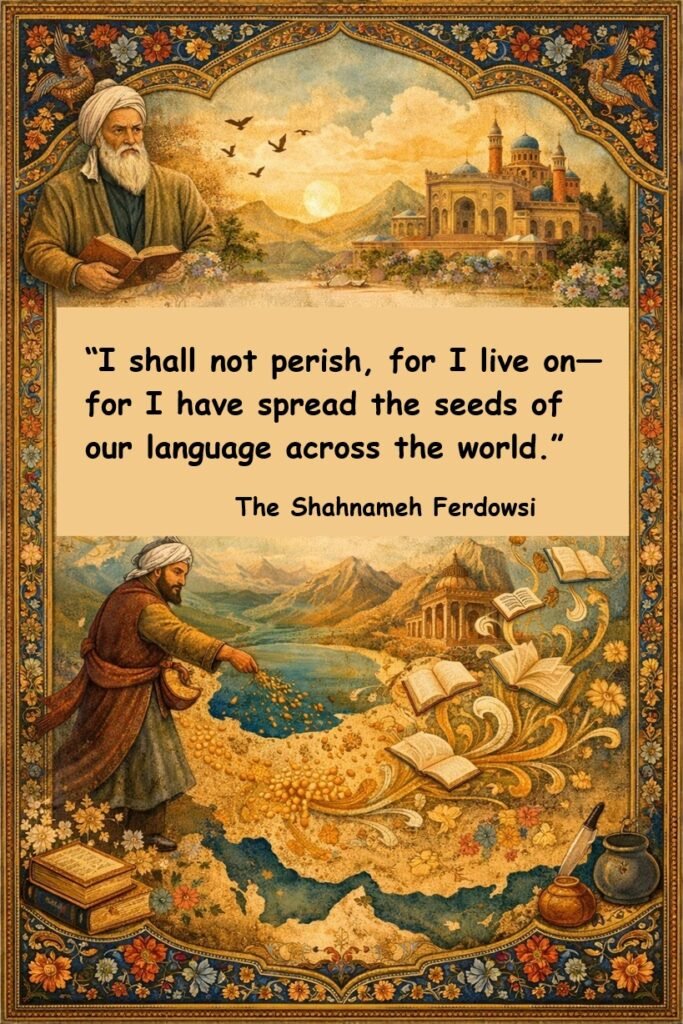
“I shall not perish, for I live on—
for I have spread the seeds of our language across the world.”
— Ferdowsi, Shahnameh