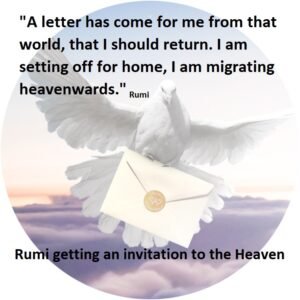
“O You who are hidden within the hidden being of my existence.” ~Rumi

Compiled and written by: Nātiq Khamūsh (The Silent Speaker)

If you are freed from worldly attachments yet hear the unspoken secret,
Tell me: what was the inner sign of that silent speaker?

And if, like Jonah, you were freed from the prison of fish and sea,
Tell me—what was the meaning of that sea, its waves, and its raging?

Introduction

A meadow whose flowers may bloom until eternity,
An idol whose beauty both worlds may sacrifice.

At dawn, the king of beauties strides forth to hunt,
For by the arrow of his glance, our hearts are caught.

From his eyes, what messages reach mine at every moment,
So that both eyes grow drunk and blissful from his signs.

The purpose of this writing is to introduce the lofty station of Rumi as a mystic, a spiritual mentor, and a Sufi who understood love in its true sense and who, nearly 600 years before the advent of the Bahá’í Faith, had perceived the exalted station of Bahá’u’lláh and was preparing the lovers of truth for His appearance. It also examines the role of Shams of Tabriz in introducing divine love to Rumi, as well as the spiritual similarities between the Sacred Writings and Rumi’s poetry, which have been briefly compiled in this collection.

In this book, all poems for which no source is cited are by Rumi. To locate the complete poems, you may search the Ganjoor website (https://ganjoor.net/moulavi).


Rumi breathed a new spiritual life into the body of Islam, and through his mystical poetry prepared the ground for the appearance of Bahá’u’lláh. He demonstrated that the foundation of all divine religions is one, and that all God’s Messengers are like lamps which, at different times, illuminate humanity according to the capacity of understanding of the people of their age. He calls upon us to focus on the light of the lamp, not on the lampstand.


From Tabriz, the Sun of Faith comes to me like a new moon —
Turn your gaze toward the light, not toward the lampstand.

Rumi breathed a new spiritual life into the body of Islam, and through his mystical poetry prepared the ground for the appearance of Bahá’u’lláh. He demonstrated that the foundation of all divine religions is one, and that all God’s Messengers are like lamps which, at different times, illuminate humanity according to the capacity of understanding of the people of their age. He calls upon us to focus on the light of the lamp, not on the lampstand.


Islamic traditions state that the dispensation of Islam would last one thousand years if its followers were righteous, and five hundred years if they were not. It has been attributed to ‘Abdu’l-Bahá that the Islamic dispensation lasted five hundred years, but that God, for the sake of Rumi, extended it by another five hundred years. It should be noted, however, that the author has not found this statement in any of the Bahá’í Writings; it may originate from notes or recollections of pilgrims who heard it orally from ‘Abdu’l-Bahá.


Mr. Khosrow Dehqani writes in his book The Sun of Certitude:

“His Excellency Abu’l-Qásim Afnán stated: I heard from early believers of Shiraz who had attained the presence of ‘Abdu’l-Bahá that they had requested an explanation of the hadith:

‘If my community is righteous, its term is one day; if corrupt, half a day; and a day with thy Lord is as a thousand years of your reckoning.’

(‘A day’ here referring to the Qur’anic verse stating that one day with God is equal to a thousand human years.)

In response, He said: ‘The meaning refers to the dispensation of Islam.’

The believers replied: ‘Before the body of the Messenger of God was even buried, disagreement arose among the leading companions, and the foundation of corruption spread throughout the Muhammadan Faith. Why, then, did the appearance of the Promised Qá’im not occur in the year 600 AH?’

He replied: ‘The appearance of Mawlaví and the Book of the Mathnawí was like a candle (a pillar of light) placed beneath a wall, and thus the dispensation of Islam reached twelve hundred years.’”

Khosrow Dehqani, The Sun of Certitude

If you grow thirsty for the ocean of meaning,
Take a respite on the island of the Mathnawí.

Pause long enough, and in every breath,
You will see the Mathnawí as wholly spiritual.

Shaykh Bahá’í, in praise of the Mathnawí, says:

“I do not claim that this noble one is a prophet,
Yet he possesses a holy book.”


Spiritual and mystical truths have existed infinitely since the dawn of creation, but in a hidden and veiled form. The divine Messengers gradually revealed these truths according to the understanding and capacity of the people of their time. Because these truths were new and unfamiliar to the people of each age, most religious scholars labeled them heretical and opposed the Messengers with all their might, sparing no cruelty—harassment, torture, imprisonment, and even execution.

In addition to the divine Messengers, certain true mystics—such as Mansur Hallaj or Rumi—when they perceived some of these mystical secrets, experienced a sudden transformation of life and tasted true love. Some, like Mansur Hallaj, were executed, while others, like Rumi, chose silence and expressed their inner truths only through metaphor and allusion:

The soul and heart cannot endure such a blaze—
With whom can I speak, when there is not a single ear in the world?

Bahá’u’lláh revealed many of these mysteries and demonstrated the correctness of Rumi’s mystical understanding. These mysteries are truths that few have recognized to this day or grasped in their true meaning. One of the aims of this site is to reveal this reality through a comparison of Rumi’s poetry and the Bahá’í Writings—showing that it was Bahá’u’lláh who, through the tongue of Shams, acquainted Rumi with these truths.


Recent Posts

Talk to us

Have any questions? We are always open to talk about your opinion