
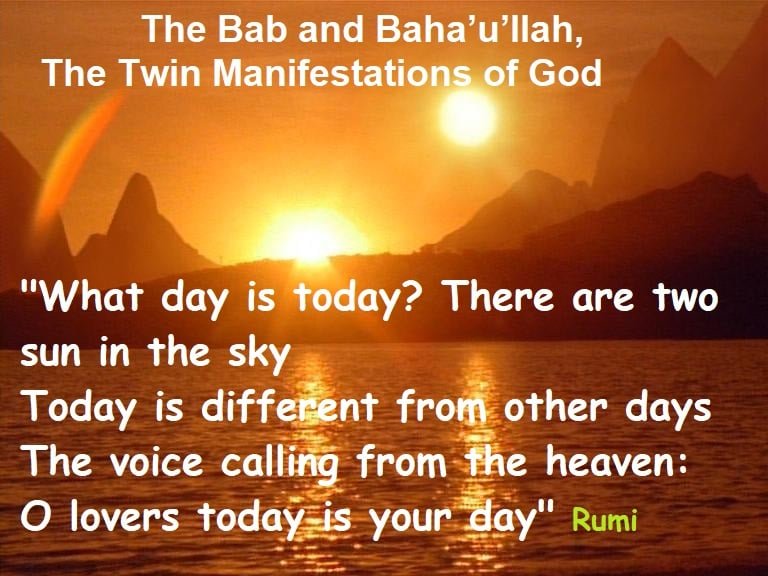
Depart, O sorrow, from the breast, for the Beloved’s grace is coming;
And you too, O heart, be lost to me, for that Heart-ravisher is coming.
I will not wish the Beloved joy, for He has passed beyond all joy;
From the excess of His love, even joy comes to me as a shame.
O Muslims, O Muslims, renew your faith from its very root;
For from shame before my Beloved, even unbelief comes in Muslim guise.
Rumi calls upon Muslims to be true Muslims, because in that time unbelief will present itself under the name of Islam.
Go, O gratitude—for this blessing has passed beyond the bounds of thanks;
I will not seek patience, though at times it too may have its use.
What light is this, what radiance is this, what moon and sun are these?
Is it that secluded Beloved, coming forth from mountain and cave?
Before declaring His Mission in Baghdad, Bahá’u’lláh lived alone and apart from all others for two years in a cave in the mountains of Sulaymaniyah.
Begone, all former forms, for new forms are arriving;
Your banners will be overturned, for the One of great abundance is coming.
He brings a new order that overturns all former orders.
The world’s equilibrium hath been upset through the vibrating influence of this most great, this new World Order. Mankind’s ordered life hath been revolutionized through the agency of this unique, this wondrous System—the like of which mortal eyes have never witnessed.
Bahá’u’lláh, Kitáb-i-Aqdas, p. 270.
Publisher: Bahá’í World Centre, 1992.
The doors and walls of this breast are being torn apart by the sheer multitude;
For what cannot enter through the door comes crashing through the walls.
In previous religions, the works that have remained directly from the divine Messengers are very limited. For example, from Moses only the single tablet of the Ten Commandments is said to have remained, while the rest of the Torah was written by later prophets of the “Children of Israel”. The Gospels, too, were written years after the martyrdom of Jesus by some of His disciples. In Islam, only the Holy Qur’an is considered direct divine revelation, while other writings and books were authored by the Imams, the Rightly Guided Caliphs, or later collectors of “Hadis”.
By contrast, from Bahá’u’lláh and the Báb, countless tablets and books were revealed—so abundant that, in the words of Rumi, “they cannot fit through the door.”