This ghazal proclaims the glad tidings of the advent of the Promised One of all religions.
How fortunate is the one whom God has called to You;
Enter, enter—for God has opened the door of heaven to you.
Bahá’u’lláh states:
O Salmán! The door of the knowledge of the Ancient Being hath ever been, and will continue forever to be, closed in the face of men. No man’s understanding shall ever gain access unto His holy court. As a token of His mercy, however, and as a proof of His loving-kindness, He hath manifested unto men the Daystars of His divine guidance, the Symbols of His divine unity, and hath ordained the knowledge of these sanctified Beings to be identical with the knowledge of His own Self. Whoso recognizeth them hath recognized God. Whoso hearkeneth to their call, hath hearkened to the Voice of God, and whoso testifieth to the truth of their Revelation, hath testified to the truth of God Himself. Whoso turneth away from them, hath turned away from God, and whoso disbelieveth in them, hath disbelieved in God. Every one of them is the Way of God that connecteth this world with the realms above, and the Standard of His Truth unto every one in the kingdoms of earth and heaven.
Therefore, the only way to recognize God is through recognizing His Manifestation of Revelation—that is, the divine Messengers. Here, Rumi says: blessed is the one who has come to realize this truth.
He who opens the doors—the Opener of all doors;
He who bestows the dwelling and the station—“We it is who send down.”
“We it is who send down” is from verse 23 of Sūrat al-Insān of the Holy Qur’an:
“Indeed, We ourselves have sent down the Qur’an, a gradual revelation.” (76:23)
God opens the doors step by step, and gradually the world becomes prepared for the advent of the Universal Manifestation of God. Always before each new divine ظهور (Dispensation), God prepares humanity little by little—through historical events and through the appearance of enlightened figures such as Rumi, as well as geniuses in all fields of art, science, industry, social life, politics, and religion—by creating a new generation and readying the world for the next revelation.
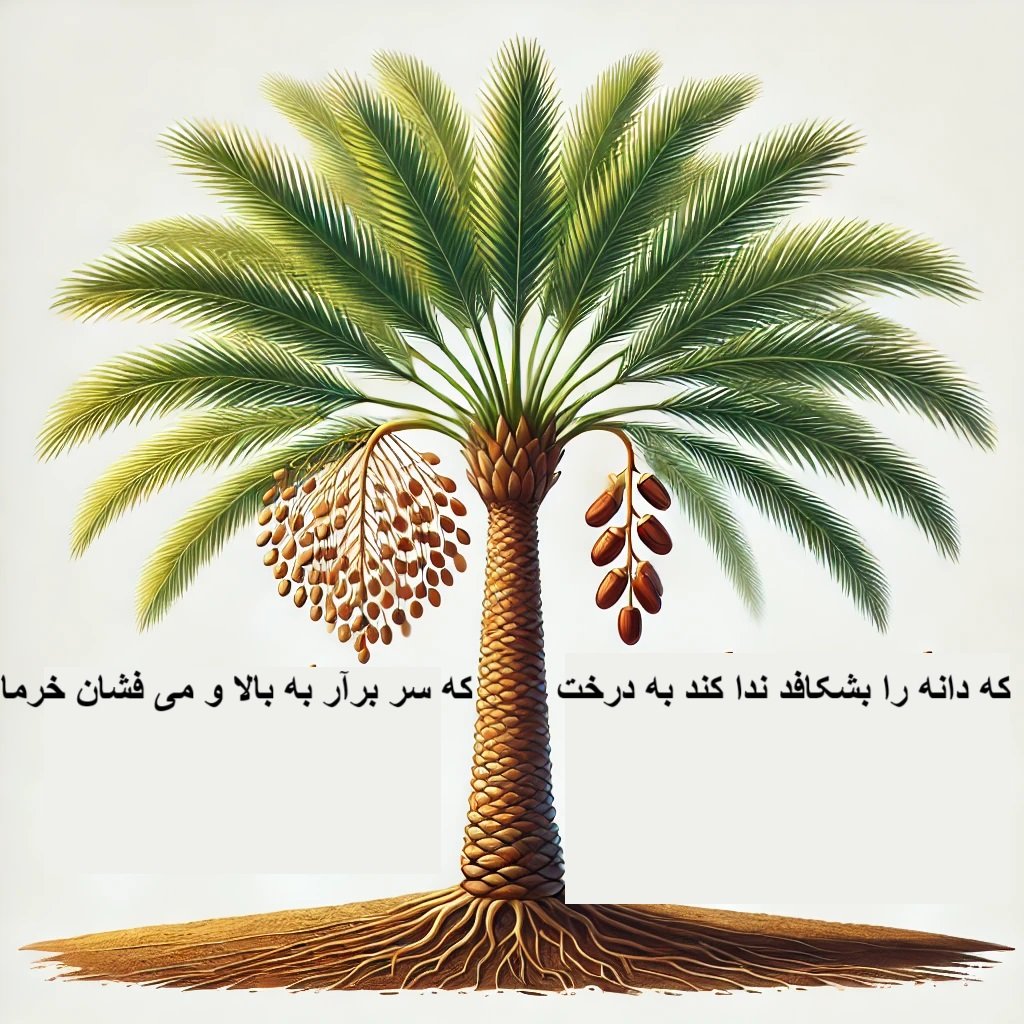
He who splits the seed and calls out to the tree:
“Rise upward and scatter dates.”
Just as the Lord commands the date seed to split open, grow into a tall tree, and bear fruit, He likewise commands His Messengers to arise and nurture humanity—to educate souls, foster growth, and bring forth the fruits of spiritual maturity.
He breathed into that reed which lay hidden beneath the earth,
So that Shirin heeded her mother, and Khusraw was restrained from halva.
Khusraw halva is taken from Nizami’s Khusraw and Shirin, in which Shirin listens to her mother’s advice:
I am that Shirin, a fruit-bearing tree,
Bearing both halva and rose-water.But for one who has a fever, tasting halva is not worth it—
For it brings years of suffering from bile.
A feverish person should not eat halva or sweets, because it will result in years of illness and imbalance. (By this, Shirin means that even tasting a single moment of physical union with Khusraw is not worth the sorrow of waiting and separation, nor is it worth the anguish and stigma of losing one’s maiden honor.)
So who was it that breathed into that sugarcane which grew from beneath the earth? And who was it that listened to the counsel of Shirin’s mother?
The “reed” (ney) alludes to the human spirit, which has taken residence within the bodily form made of earth, and Shirin’s mother symbolizes the divine Messengers, who guide, warn, and nurture humanity through wisdom and moral counsel.
He who turned the earth in the miner’s hand into gold and silver,
He who transformed water within a shell into pearls.
What is meant by the appearance of the divine Messengers is the transformation of the human being—from worthless dust into a precious jewel, from insignificance into true worth.
His Blessed Beauty states:
The Purpose of the one true God, exalted be His glory, in revealing Himself unto men is to lay bare those gems that lie hidden within the mine of their true and inmost selves….
You were freed from soul and body by the rapture of the Beloved;
You passed beyond qāba qawsayn (the length of two bows)—drawn to even nearer by His attraction.
Qur’anic reference:
This alludes to verse 9 of Qur’an, Sūrat al-Najm (53:9), describing the Mi‘rāj of the Prophet Muhammad:
“Then he drew near and came closer,
until he was at a distance of two bow-lengths or even nearer.”
(qāba qawsayn refers to a unit of measure used at the time—the length of two bows.)
Explanation:
Here, Rumi addresses the Manifestation of God, saying: You renounced all comforts of soul and body for the sake of nearness to God. By surrendering every attachment, the Manifestation transcends all limits of distance and measure, reaching the utmost intimacy with the Divine—not by physical ascent, but by complete self-effacement and attraction to God.
Even the sun has become your minstrel, calling out: Rise—prostrate!
From the hand of the tulip comes the cry toward the stature of the cypress.
All of creation proclaims the glad tidings of the advent.
The sun, the flowers, and the forms of nature become heralds, summoning humanity to recognition, reverence, and awakening before the rising of the Beloved’s presence.
Why does the phoenix of the soul soar so high?
It has heard the clarion call from the Most Exalted Lord.
Why is the call of this Manifestation so majestic and powerful?
Because the Lord Most Exalted ( رب الاعلی)—The Báb—has proclaimed and heralded its advent.
The soul rises and ascends because it has heard a divine summons, a call that originates not from the world below, but from the highest source of revelation.
I shall ask the blossomed rose why it smiles—
Because its prayer was answered by that springtime of supplication.
When the flower caught the scent of Joseph of meaning from the collar,
It opened its mouth in laughter, crying: “Oh joy! Glad tidings!”
The garden says to December: Do whatever you will,
For under the splendor of the King’s justice, I fear no plunder.
After centuries of prayer, at last the supplications were answered and the Promised One of the world appeared. The divine spring arrived; the fragrance of Joseph’s shirt caused the buds to burst into laughter, the cry of “O glad tidings!” was raised—and there remains no place for sorrow.
When heaven and earth in Your grasp are worth less than an apple,
You take away my leaf—where will You lead me, and where can I go?
Adam and Eve, while in Paradise, ate from the forbidden apple; their spiritual sight was veiled and their physical sight was opened. They saw that they were naked and used tree leaves to cover themselves.
Here, Rumi is saying that the Manifestation of God brings us back to Paradise. With the opening of the spiritual eye, there is no longer any need for leaves—no need for concealment, shame, or outward coverings.
When inner vision is restored, humanity returns to its original dignity and innocence, clothed not in leaves, but in spiritual awareness and divine light.
Since He is the very Meaning of the universe, by the consensus of all,
Where could the names go except in service to Meaning?
The name of the Manifestation became the Manifestation of Meaning—love;
By the command “that I may be known,” the insight of the gnostics found release through the Name.
Because God is the inner Meaning (ma‘nā) of all existence, all names, forms, and attributes have no purpose except to serve and point toward that Meaning. When the Manifestation of God appears, His very name becomes the Manifestation of Meaning itself, and that Meaning is love.
The phrase «کاردت اَن اعرف» alludes to the well-known sacred tradition:
“I was a hidden treasure; I loved to be known, so I created creation that I might be known.”
Creation, therefore, is born from love, and recognition of God occurs through His Manifestation. Through this recognition, the gnostics (ʿurafā) attain inner freedom and true insight.
Bahá’u’lláh states:
“The cause of the creation of contingent beings hath been love, as mentioned in the well-known tradition wherein He saith: ‘I was a hidden treasure and loved to be known; therefore I created creation that I might be known.’ Hence must all be united in the law of divine love, in such wise that no trace of discord may in any way arise among the loved ones and companions.”
— Bahá’u’lláh, Prayers and Meditations, p. 480 (Provisional translation)
In this light, Rumi and Bahá’u’lláh speak with one voice:
Love is both the reason for creation and the path to recognition.
Aaron recognizes Moses through the gnosis,
Even if there is no staff, and even if there is no radiant hand.
The meaning is that divine Messengers do not need outward miracles to be known.
Even without Moses’ staff or the miracle of the shining hand (yad-e bayḍāʾ), truth is recognized through insight, wisdom, and the power of the Word.
Rumi is saying that spiritual knowledge (maʿrifat)—embodied here by Aaron’s discernment—recognizes the Manifestation of God without reliance on signs and wonders. The true miracle of the prophets is their speech, their message, and their transformative word, which awakens hearts and reveals meaning.
In other words:
Miracles may convince the eye, but the Word convinces the soul.
How could the heavens not revolve around the roof and door of His abode,
When the sun and the moon themselves give generously from His light?
Rumi is saying that all existence turns around Him—the axis of being is the Manifestation of God. The motion of the cosmos is not random; it is drawn by a spiritual center. Even the sun and the moon, which appear as sources of light, are in truth receivers and distributors of His radiance.
Thus, all generosity, illumination, and order in the universe flow from that single divine Source, and creation itself moves in devotion around Him.
Since God named Himself Bahā (Light),
Show reverence to the one who lives by that Light.
In this poem, the name of the Manifestation of God as Light is “Bahā” (Splendor). Rumi elsewhere explicitly plays on this divine name:
The world is filled with my light—look with my eyes;
They named me Bahā, though I am beyond all price.
I have passed beyond all this—guard your hand well,
For our Joseph comes forth drunken from behind the veil.
What place is there for the hand? Reason and sense are lost as well,
For the cupbearer is heart-ravishing, and His wine is irresistible.
Rumi alludes to the story of Joseph and the women of Egypt, who—overwhelmed by the majesty of Joseph’s beauty—cut their hands instead of fruit without realizing it. Here, Rumi warns:
Be careful of your hand, for Joseph is approaching from behind the veil.
But the meaning goes further:
This is not only about the hand —it is about reason and intellect themselves. When the beauty and truth of the Manifestation of God appear, not only do outward faculties fail, but mind and calculation are also taken away.
The cupbearer symbolizes the divine Bestower,
the wine is spiritual attraction and revelation,
and Joseph represents the unveiled beauty of truth (Baha’u’llah).
In other words, when true revelation appears, self-control, rational pride, and ordinary awareness dissolve, and the soul is seized by a love and recognition that surpass all measure.
Be silent, so that He Himself may tell the explanation of this;
For the true splendor is better when it descends from above.
Here, as in many of his ghazals, Rumi reminds himself to be silent. The truth of the matter cannot be fully expressed in words before its time. When the One Himself appears, He will speak—and His speech will be clearer, stronger, and more radiant than any prior explanation.
This meaning is reinforced by the other verse you cite:
When He commands, “Be silent,” I become silent;
That Prince Himself will one day tell the explanation.
Human speech has limits. Revelation speaks for itself.
Until that moment arrives, the wisest response is silence, readiness, and humility—for when the Sun rises, there is no need to describe the light.