
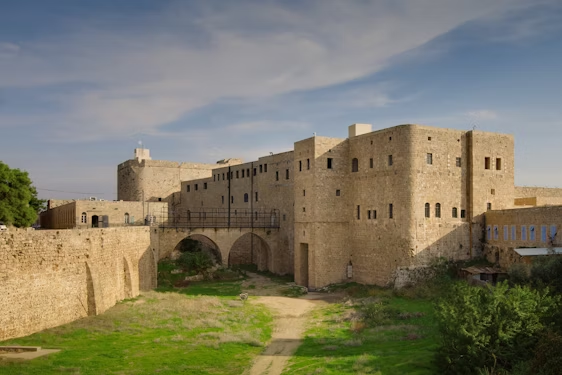
The Meeting with Bahá’u’lláh in the Prison of the Most Great Prison (Sijn-i-A‘ẓam)
As we know, in the spiritual realms there is no time or place. Time is something we ourselves created in the material world through the earth’s rotation around the sun, forming years, and through the rotation of the moon and the earth upon their axes, forming months and days. In the spiritual world, there is no need for a calendar.
‘Abdu’l-Bahá states in one of His Tablets:
It is a spiritual realm, a divine world, and it is the seat of the sovereignty of the almighty Lord. It is exalted above bodies and all that is corporeal, and it is freed and sanctified from the idle conjectures of men. For to be confined to place is a characteristic of bodies and not of spirits: Time and place encompass the body, not the mind and the soul.
He also states in Some Answered Questions:
In the world of God there is no past, present, or future: All of these are one. So when Christ said, “In the beginning was the Word,” He meant that it was, is, and shall be; for in the world of God there is no time. Time holds sway over the creatures but not over God. So in the prayer where Christ says, “Hallowed be Thy name”, the meaning is that Thy name was, is, and shall be hallowed. Again, morning, noon, and evening exist in relation to the earth, but in the sun there is neither morning, nor noon, nor evening.
Bahá’u’lláh spent most of His earthly life in imprisonment and exile, yet He named the fortress of ‘Akká the Most Great Prison because of its extreme hardships and sufferings. He writes:
This Wronged One, however, remained calm and silent in the Most Great Prison, busying Himself with His own affairs, and completely detached from all else but God. Iniquity waxed so grievous that the pens of the world are powerless to record it.
In another Tablet, the Blessed Beauty declares:
He is the Exalted:
“In the Name of the One God. The Beloved of the worlds dwells in the Most Great Prison. You have recognized the worth of this wrongfulness—so recognize it yourself. By the life of God, wrongfulness is exceedingly beloved. Secretly drink from the Kawthar of divine knowledge and value it. Days of outward triumph will come, but they will not possess this sweetness. If you reflect rightly, you will behold the greatness of the Cause in this very condition. This is the sweetest utterance that flowed from the Supreme Pen. Blessed are you for what you have attained.”
Má’idiy-i-Ásmání, Vol. 4, p. 372
National Bahá’í Publishing Trust – Iran, Badí‘ 129
When my soul was drawn toward the prison from on high,
I was torn from the ranks of His intimates and became a lonely stranger.
In the early years, by order of the Ottoman government, no one was permitted to visit the Blessed Beauty. After long and arduous journeys to ‘Akká, the believers would wait outside the fortress, and Bahá’u’lláh would wave to them from the prison window. Gradually, restrictions were eased, and the believers were allowed to enter the fortress and, through close relatives and trusted companions, attain His presence.
Suddenly, in the midst of confinement, the Moon became my companion,
And in an instant cast into my mind a thousand longings.
Suddenly, he found himself in the presence of his Lord.
All seek deliverance from affliction and prison—but not I.
Where could I go, where turn my face, when my Beloved is here?
I find no private meeting with Him except within the prison’s corner,
For only fire can fully purify the honeyed heart.
No one desires imprisonment, yet when one’s Beloved is in chains, where is better than at the Beloved’s side?
In another ghazal, Rumi says:
“If we are in the garden without you, our rose-bed turns to thorns;
If we are in prison with you, roses bloom from our thorns.”
Cast a glance toward the kin, a glance toward the distraught,
A glance toward longing, a glance toward this vision.
When Joseph is one’s companion, who could remain tender?
Turn the prison into a garden—especially when it is our Joseph
In Rumi’s works, Joseph symbolizes divine beauty, here referring to the Blessed Beauty. In The Seven Valleys, Bahá’u’lláh explains the Valley of Love:
And if, by the help of the Creator, he findeth on this journey a trace of the traceless Friend, and inhaleth the fragrance of the long-lost Joseph from the heavenly herald, he shall straightway step into the Valley of Love and be consumed in the fire of love. In this city the heaven of rapture is upraised, and the world-illuming sun of yearning shineth, and the fire of love is set ablaze; and when the fire of love is ablaze, it burneth to ashes the harvest of reason.
Now is the wayfarer oblivious of himself, and of aught besides himself. He seeth neither ignorance nor knowledge, neither doubt nor certitude; he knoweth not the morn of guidance from the night of error. He fleeth from both unbelief and faith, and findeth in deadly poison his heart’s relief.
(The Call of the Divine Beloved)
“The fragrance of the lost Joseph” signifies recognition of Bahá’u’lláh, and the “the heavenly herald” refers to the Báb, His Forerunner.
With eyes and vision he runs toward the prison, whoever seeks Him,
For from such a sugar-garden arises such a yearning.
I heard from the stars that if anyone finds
A trace of that moon’s light—bring us the news.
Here, the “stars” symbolize the believers in Bahá’u’lláh, those who draw their light from the Sun of Bahá. Rumi speaks on their behalf, saying: whenever the Manifestation appears, inform us, so we may be illumined by His light.
When you reach this jewel, you will, by grace,
Set foot like Moses and cross seven seas.
When one attains this station, one can part the seas like Moses. In the same Valley of Love, Bahá’u’lláh states:
Love accepteth no existence and wisheth no life: In death it seeth life, and in shame it seeketh glory. To merit the madness of love, one must abound in sanity; to merit the bonds of the Friend, one must be free in spirit. Blessed the neck that is caught in His noose, and happy the head that falleth on the dust in the path of His love. Wherefore, O friend, renounce thy self, that thou mayest find the Peerless One; and soar beyond this mortal world, that thou mayest find thy nest in the abode of heaven. Be as naught, if thou wouldst kindle the fire of being and be fit for the pathway of love.
Its news, from jealousy of souls, never reaches moon or star,
For when that moon rises, it melts the heavens.
The melting of the heavens is among the signs of the Day of Resurrection—the Day of the appearance of a new Manifestation. In the Qur’án, Súratu’l-Ma‘árij (70:8), it is stated:
“On the Day when the heavens will be like molten metal.”
Thus, “when that moon rises, it melts the heavens” signifies that the advent itself is the Resurrection.
I am ashamed to describe His face—by God, I close my mouth.
What could a water-skin draw from the sea, or from the musk-filled ocean?
Rumi confesses his inability to describe that Beauty, saying that his capacity from that infinite ocean is no more than a single water-skin.