
Close your lips like a bud upon the path of a newborn child,
And listen—from the cypress and the lily—to the stories of freedom.
In July 1848, a historic gathering took place in the small town of Seneca Falls, New York. Known as the Seneca Falls Convention, it was the first organized women’s rights convention in the United States. Organized primarily by Elizabeth Cady Stanton and Lucretia Mott, the convention brought together about three hundred women and men who sought to challenge the long-standing legal and social inequalities faced by women.
The convention produced the Declaration of Sentiments, a document modeled after the United States Declaration of Independence. In it, the organizers proclaimed that “all men and women are created equal.” The declaration listed grievances against the social, political, and economic limitations imposed on women, including denial of voting rights, limited access to education, and lack of legal independence within marriage. This gathering marked the formal beginning of the organized women’s rights movement in the United States and later became a cornerstone of the broader movement that led to women’s suffrage.
The Conference of Badasht and Tahereh’s Revolutionary Act
Almost at the same moment in history—during the summer of 1848—another remarkable event unfolded thousands of miles away in Persia (modern Iran). The Conference of Badasht, organized by leading followers of the The Báb, was convened to clarify the future direction of the emerging Bábí movement.
Among the most influential participants was the brilliant scholar, poet, and spiritual leader Táhirih. During the conference, Táhirih performed an act that shocked Persian society: she appeared unveiled before the assembled men. In the deeply traditional culture of nineteenth-century Persia, where strict veiling symbolized social and religious norms, this gesture carried immense significance.
Táhirih’s unveiling was not merely a personal act of defiance; it was a symbolic declaration of a new spiritual and social era. She proclaimed the end of old religious constraints and affirmed the spiritual equality and dignity of women. Her bold action transformed the conference into a turning point in the history of the Bábí movement and marked one of the earliest explicit proclamations of women’s emancipation in the modern Middle East.
A Remarkable Coincidence in World History
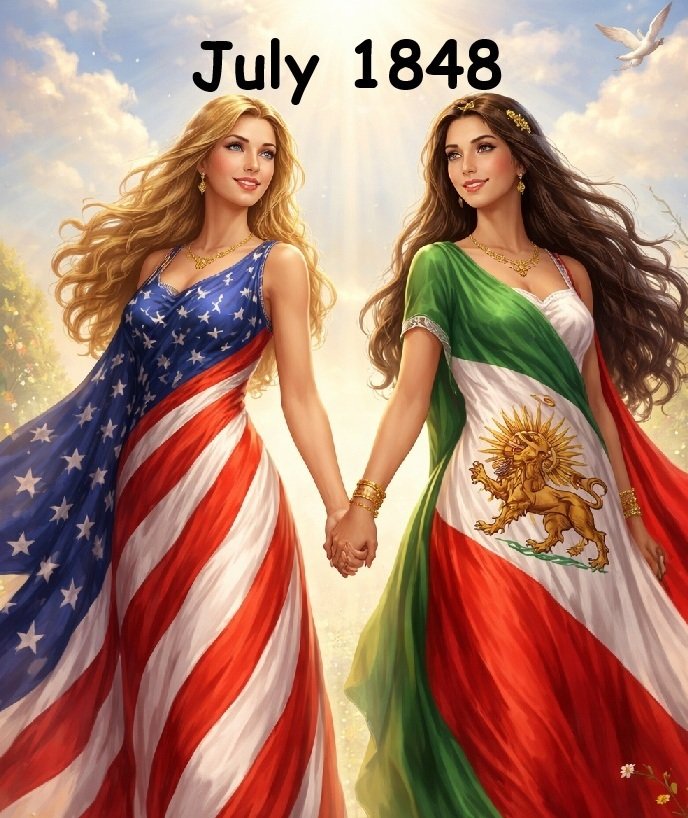
The striking aspect of these two events is their near simultaneity. In July 1848, while women in the United States gathered publicly at Seneca Falls to demand equal rights, a woman in Persia stood before a gathering of religious reformers and symbolically cast aside the veil that represented centuries of gender restriction.
These two moments occurred independently, in vastly different cultural contexts—one in the industrializing West and the other in the traditional societies of the East. Yet both represented the awakening of a new consciousness about the role and dignity of women.
At Seneca Falls, the call was expressed through political language and civil rights. At Badasht, it appeared through spiritual symbolism and religious renewal. One was framed within the democratic ideals of modern political reform; the other within a profound spiritual revolution emerging in Persia.
Despite these differences, the parallel timing of these events suggests a deeper historical rhythm. Across continents and cultures, the mid-nineteenth century witnessed a powerful stirring toward the recognition of women’s equality.
East and West Moving Toward the Same Horizon
Viewed together, the Seneca Falls Convention and the Conference of Badasht appear like two lights igniting almost simultaneously on opposite sides of the world. One was articulated through reform movements and political advocacy; the other through prophetic courage and spiritual symbolism.
Both events helped open a path toward the transformation of women’s roles in society. While the struggle for equality would continue for generations, these moments in 1848 stand as early signals of a global change—an awakening that suggested humanity was beginning to move toward a broader recognition of the equal dignity and capacity of women and men.
In this sense, the events at Seneca Falls and Badasht can be seen as parallel heralds of a new age, one arising in the West and the other in the East, both announcing that the time had come for women to claim their rightful place in the unfolding story of human civilization.