In this ghazal, the exalted station of the human being is explained, and God calls the believers unto Himself.
Beloved, how long will you remain in the land of strangers?
Return from this exile—how long this sorrow and disarray?
Every world other than the spiritual world is a land of exile and strangers.
“They seek none but Thee, desire none but Thee, speak of no secret save Thy secret.
Be Thou our Protector, be Thou our Deliverer; grant freedom to every captive,
release them from the chains and fetters of self and desire;
enable them to attain servitude, humility, freedom, and simplicity;
deliver them from immaturity, defilement, weariness, and stagnation.
Verily, Thou art the Mighty, the Powerful.”
—Selections from the Writings of ‘Abdu’l-Bahá, vol. 3, p. 181Provisional translation.
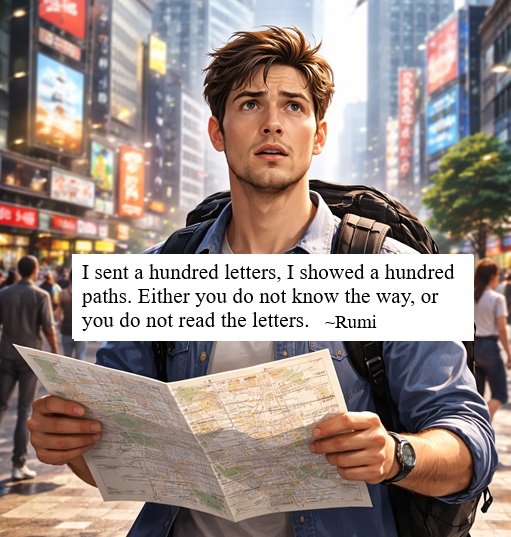
I sent a hundred letters, I showed a hundred paths—
Either you do not know the way, or you do not read the letters.
The hundred letters allude to the Heavenly Books, and the hundred paths to the teachings of the Divine Messengers.
Bahá’u’lláh says:
“Say: O friends! The Guide has come. His word stands out among all words,
His path is manifest among all paths. The path is His—find it.
The word is His—listen to it. Today the cloud of divine bounty pours forth,
the sun of knowledge shines and guides unto itself. Noble is he who abandons the paths of conjecture and takes the path of God.”
—Yárán-i-Pársí, p. 582. Provisional translation
And also:
“O servants! Truly I say: the truthful one is he who has seen the straight path.
That path is one; God has chosen it and prepared it.
Among all paths it is like the radiant sun among the stars.
Whoever has not attained this path is unaware and astray.
This is the word of the One, the Incomparable God.”
And in the same Tablet:
“O servants! Renounce your own desires and desire what I desire.
Walk not a path without a guide, nor accept every claimant to guidance.
Many guides are misguided and have not found the straight path.
A true guide is one who is free from the bondage of time
and whom nothing restrains from speaking the truth.”
—Yárán-i-Pársí, p. 582. Provisional translation
If you do not read the letters, the letter itself will read you;
If you do not know the way, you are held in the grasp of the Way-Knower.
Even if a person neglects the Divine Books, God does not abandon them;
He reads His signs within their hearts. As stated in the Qur’an (41:53):
“We shall show them Our signs on the horizons and within themselves
until it becomes clear to them that this is the Truth.
Is it not sufficient that thy Lord is a witness over all things?”
Through divine tests, the human being is always in the grasp of the Knower of the Way. Bahá’u’lláh says:
I desire communion with thee, but thou wouldst put no trust in Me. The sword of thy rebellion hath felled the tree of thy hope. At all times I am near unto thee, but thou art ever far from Me. Imperishable glory I have chosen for thee, yet boundless shame thou hast chosen for thyself. While there is yet time, return, and lose not thy chance.
Return—for in that prison none knows your worth;
Do not sit with stone-hearts, for you are a jewel of this mine.
“Praise be to God! Divine grace has guided the sincere to the straight path
and bestowed upon them the greatest gift and supreme bounty.
Know the value of your station and remain ever vigilant,
for the misguided lie in wait for the guides.”
—Bahá’u’lláh, Iqtidārāt, p. 276. Provisional translation
“O essence of the mine of the love of God!
Every gem has its mine, every pearl its ocean shell.
The servants of God are the jewels of existence…
Strive, therefore, to be a radiant gem.”
—Writings of ‘Abdu’l-Bahá, vol. 7, p. 122. Provisional translation
You who have escaped heart and soul, washed your hands of both,
Fled the snare of the world—return, O royal falcon.
On His path one must relinquish heart and soul, and soar like a falcon in the divine sky.
“Blessed the eye that turns away from the corrupted outer beauty
to behold the beauty of the Divine Identity…until the whole body becomes soul,
and the entire form the dwelling of the Beloved.”
—Bahá’u’lláh, La’ālī-yi Ḥikmat, vol. 3, p. 275. Provisional translation
You are both water and stream, both seeker and sought;
Both lion and gazelle—indeed, greater than all of these.
Everything is within you; your station surpasses all created beings.
How long will you stand apart from your own soul—are you less than it, or more?
Are you merely joined to the soul, or a beam from the Soul itself?
Your spirit takes its light from God why mingle it with the perishing world?
Moonlight in the night, sugar upon the lips—
O Lord, what a wondrous divine creation!
Whenever God sends a Messenger, we offer our very life and head in His path—what bargain could be better than this?
As the Qur’an says: “Blessed is God, the Best of creators.”
To give life and soul in His path—what trade is sweeter than this?
To die like sugar for His love, to drink poison as the water of life.
To die in the love of God is sweetness; from His hand even poison becomes the source of eternal life.
“The pure are free, and the lovers even long for the trials inflicted by the Beloved.
That is, they are so content with the divine decree that they regard the cup of affliction as pure honey,
and the poison of trial as the nectar of everlasting life.
For without this, they cannot attain the station of submission and contentment.
The meaning of contentment (riḍā) is this: that bitterness becomes sweetness,
poison turns to sugar, and lethal venom is transformed into honey and ambrosia.”
— Selections from the Writings of ‘Abdu’l‑Bahá, vol. 2, p. 126. Provisional translation.