
This cry of the reed is fire, not wind;
Whoever does not have this fire—let them be nothing.
Fire has held a central place in ancient Eastern philosophy as both a physical element and a profound metaphysical symbol. In early Indo-Iranian, Vedic, and Zoroastrian traditions, fire was understood as a living presence that mediates between the human and the divine. The Vedic Agni, for example, was not merely flame but the sacred messenger that carried offerings to the gods, embodying transformation, purification, and cosmic order. Fire’s upward movement and luminous nature made it a natural symbol of consciousness aspiring toward truth and transcendence.
In Persian and Iranian philosophical traditions, especially within Zoroastrian thought, fire represented asha—truth, order, and righteousness—rather than being an object of worship in itself. Fire temples preserved flame as a visible sign of divine wisdom and moral clarity, reflecting the belief that light reveals reality while darkness conceals it. This symbolic understanding later influenced Islamic-era philosophies such as Hikmat al-Ishrāq (Illuminationist philosophy), where thinkers like Suhrawardi described existence as a hierarchy of lights, with fire serving as a bridge between material substance and immaterial illumination.
In broader Eastern mysticism, including Taoist, Buddhist, and Sufi traditions, fire came to signify inner transformation and awakening. It is the fire of discipline that refines the self, the fire of love that consumes ego, and the fire of insight that dissolves illusion. Rather than destruction, fire represents becoming—the necessary burning through which ignorance is reduced to ash and wisdom emerges. Across these traditions, fire stands as a universal metaphor for the soul’s journey from density to luminosity, from form to meaning, and from knowing to being.
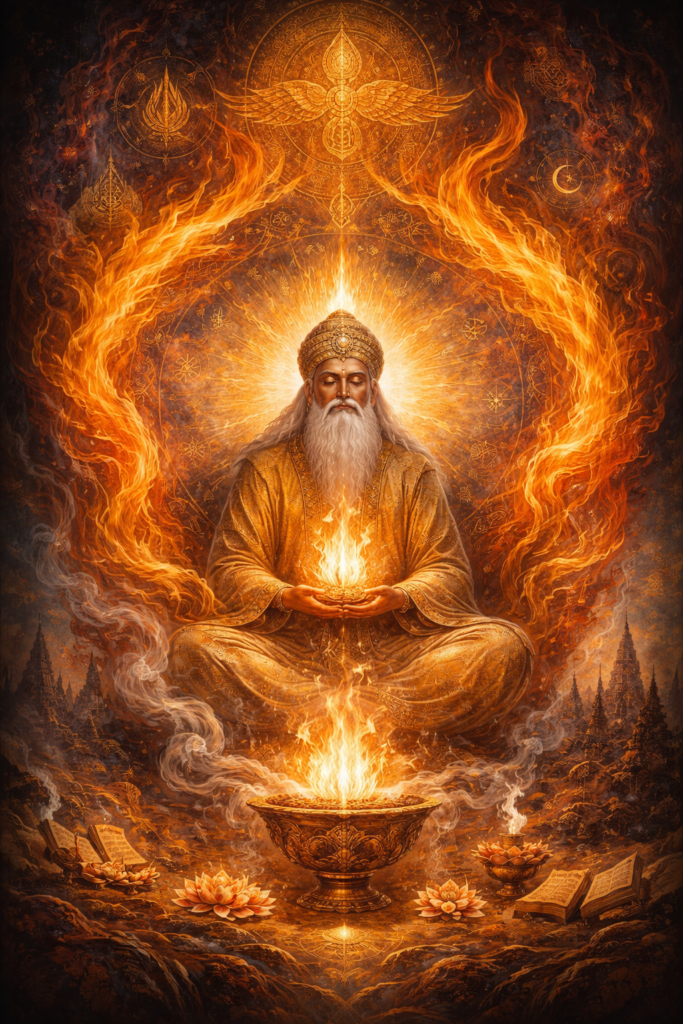
What is the role of light and fire in the religion of Asho Zoroaster?
The following materials are taken from an article by Mobed Dr. Ardeshir Khorshidian published on the Amordad website:
3,743 years ago, Asho Zoroaster recognized Asha (truth) and the order of existence, and established the foundation of his religion on monotheism. He regarded prayer as a human necessity and deemed worship worthy only of Ahura Mazda (the Great Wise Creator of existence).
Light and fire, in all major religions, are considered symbols of divine radiance and manifestations of the Creator. In the Torah, Yahweh (the God of the Jews) appears to the Prophet Moses in tongues of fire on Mount Sinai. In the Gospel, the heavenly book of Jesus Christ, it is stated that God is absolute light and that no darkness or shadow exists in Him. In the Holy Qur’an as well, in Surah al-Nur, verse 35, God is described as the “Light of the heavens and the earth.” Asho Zoroaster likewise regarded God as “Shidan-e Shid” (the Light of Lights) and perceived His manifestation in all particles of nature. Based on this belief, the direction of worship (qibla) for Zoroastrians is light.
Zoroastrians pray five times daily, with a purified body and a prepared soul, facing toward light: in the morning toward the east, in the afternoon toward the west, and at night facing the moon or a burning fire, a candle, or a lit lamp, offering the prescribed prayers to Ahura Mazda.
Fire in the religion of Zoroaster is a symbol of truth, because fire is the only element that does not absorb impurity; it always rises upward, preserves its essential nature, burns itself, and bestows warmth and light upon the world. The ashavans (seekers of truth), like the sacred fire of the fire temple, remain consistent and pure at all times, do not contaminate themselves with impurities, and bring light, joy, warmth, and energy to society.
The Aryans, contemporaries of Zoroaster, lived in the northern regions of Iran and southern Russia, areas with very cold climates and long winters. The prevailing belief among most people was nature worship. Since everyone depended on fire for lighting, heating their homes, cooking food, and other necessities—and since matches did not exist and producing fire was difficult and time-consuming—they kept fire continuously burning in a place called a fire temple (Atashkadeh).
The Prophet Zoroaster recognized the existence of such a place as essential and vital. However, by associating the fire of the fire temple with the fire of various social classes (such as blacksmiths, coppersmiths, bakers, and household hearths), he imbued it with spiritual meaning and elevated it to the status of a sacred banner.
Zoroastrians regard the fire within the fire temple as a symbol of their very existence—or, in other words, as the flag and standard of the Zoroastrian religion, embodying thousands of years of national, religious, and cultural identity. This fire is kept continuously alight by a fire-tending priest (Atarvan).
Throughout history, fire temples have been known by names such as Darb-e Mehr (Mithra Gate), Adarian, and Atash Bahram (Warharan). Historically, they have served not only as places of worship for Zoroastrians but also as religious, cultural, and social centers.
The qibla or direction of worship is the direction toward which followers of every religion around the world face when praying to God. Therefore, throughout history, the Zoroastrian qibla has never been fire itself. Mazda-worshippers only give attention to the fire within the fire temple, where it functions symbolically as a banner. Even neighbors of a fire temple do not pray facing it, nor does any Zoroastrian ask others in which direction the city’s Adarian lies in order to set their qibla. Rather, they always stand facing the light and praise Ahura Mazda and His creations.
The mastery of fire and the optimal use of it was one of humanity’s most important discoveries, accelerating civilization and human progress in a legendary manner. People all over the world, in one way or another, love fire, and at the beginning of worship they often wish to light a candle and praise goodness. The Olympic flame is kept perpetually alight and is ceremonially raised each year at the Olympic Games. The rituals of lighting fires, illuminating spaces, and fireworks on joyful occasions are customary and uplifting throughout the world.
The fire currently burning in the Yazd Fire Temple originates from the Atashkadeh Farnbagh of Pars, one of the three great fire temples of the Sassanian era. It was brought to Aqda in Yazd in the 5th century CE and kept burning there for 700 years. In the year 553 of the Solar Hijri calendar (1174 CE), it was transferred from Aqda to Ardakan, Yazd, where it was preserved for another 300 years. In 1318 Solar Hijri (1940 CE), it was moved to its present location after the completion of the building, where it has remained continuously lit to this day. The fires of the Tehran and Isfahan fire temples are also renewed annually using fire from the major social class (copper).
From ancient times, fire temples were built simply and without ornamentation. The column capitals and stone friezes of the Yazd Fire Temple, adorned with beautiful relief designs, are the work of Isfahani stone carvers and were inspired by the architecture of the Parsi fire temples of India.
End of the article by Mobed Dr. Ardeshir Khorshidian on the Amordad website.
The Role of Fire in the Bahá’í Faith
Cupbearer, bring the wine, for the days are most delightful;
Today is a day for wine, for the tent, and for fire.
In the Bahá’í Faith, fire has a primarily symbolic and spiritual significance rather than a physical one. Unlike some earlier religious traditions that used fire as a tool for worship or purification rituals (such as Zoroastrianism), in the Bahá’í religion fire is a sign of divine love, spiritual longing, and the light of guidance.
In Bahá’í texts, fire is regarded as a symbol of ardent love for God and the warmth of faith. In many of the writings of Bahá’u’lláh and ‘Abdu’l-Bahá, fire represents a force that ignites the human heart and impels it to move toward the Supreme Truth. For example:
O Befriended Stranger!
The candle of thine heart is lighted by the hand of My power, quench it not with the contrary winds of self and passion. The healer of all thine ills is remembrance of Me, forget it not. Make My love thy treasure and cherish it even as thy very sight and life.(The Hidden Words) www.bahai.org/r/889172469
The light of this inner candle inspires human beings to abandon worldly attachments and move toward the spiritual realm. For this reason, fire in the Bahá’í Faith is regarded as a sign of inner transformation and the burning away of the veils of heedlessness. On the other hand, in Bahá’í mystical thought, fire also signifies trial and testing. Just as gold is refined in fire, a person’s faith and character are purified and made sincere through the trials of life, in the fiery furnace of experiences and hardships.
Bahá’u’lláh states in The Arabic Hidden Words:
“O Son of Being!
Busy not thyself with this world, for with fire We test the gold, and with gold We test Our servants.”(The Hidden Words) www.bahai.org/r/561352140
In Bahá’í literature, especially in the Tablets and prayers, believers are at times called upon to burn like a candle and to be consumed in the path of God. This imagery, once again, draws upon the role of fire as a symbol of fanā’ fī’lláh (self-effacement in God) and selfless service.
If your beloved is fire, then go and burn within it;
In the burning night of separation, be like a candle until dawn.
Reflection upon the divine Writings ignites a fire within the human being that can become a source of illumination for the world. Bahá’u’lláh states at the end of the Lawḥ-i Iḥtirāq (Fire Tablet):
“Should all the servants read and ponder this, there shall be kindled in their veins a fire that shall set aflame the worlds.”
https://www.bahaiprayers.org/fire.htm
‘Abdu’l-Bahá states in Some Answered Questions — “The Question of the Baptism of Christ”:
“Man cannot free himself from the onslaught of vain and selfish desires save through the confirming grace of the Holy Spirit. That is why it is said that baptism must be with the spirit, with water, and with fire—that is, with the spirit of divine grace, the water of knowledge and life, and the fire of the love of God. It is with this spirit, this water, and this fire that man must be baptized, that he may partake of everlasting grace. For otherwise, of what avail is it to be baptized with material water? No, this baptism with water was a symbol of repentance and of seeking remission of sins.”(Some Answered Questions)www.bahai.org/r/114024877
In Islam and Christianity, it is promised that unbelievers and sinners will burn in the fire of Hell. Since fire purifies all impurities—and since evil has no independent existence in creation, being merely the absence of good—this fire of Hell is also the fire of God’s love, which burns away sins and prepares souls to ascend to higher realms.
Fire in the Works of Rumi
This cry of the reed is fire, not wind;
Whoever does not have this fire—let them be nothing.
It is the fire of love that has fallen into the reed;
It is the surge of love that has fallen into the wine.
The role of fire in Rumi’s works holds a profoundly deep, symbolic, and multilayered significance. In his poetry, fire appears not merely as a natural element but as a mystical, psychological, and ontological symbol
O our fair-named Joseph, how gracefully you walk upon our roof!
O you who have shattered our cup, O you who have torn our snare apart.
O our light, O our feast, O our victorious fortune!
Stir a ferment in our ecstasy, so that our grapes may turn to wine.
O our beloved and our aim, O our qibla and our object of worship!
You have set fire to our incense—behold now the smoke rising from us.
Fire as a symbol of hardships and trials:
From one fire I brought you forth;
Into another fire I spread you.
So that no evil eye might fall upon your beauty,
I rubbed your ears and caused you pain.
Fire as a cause of purification:
Last night the wandering intellect came and knocked at the door;
I said, “Who is it? Open the door and come inside.”
It said, “How can one enter a house that is fire from end to end?
It burns both worlds with the fires of ‘No.’”
I said, “Do not grieve—step inside like a brave one,
So that it may cleanse you of selfhood and you may become true being by God.”
Fire as the school of love:
The school where lovers are taught is fire;
Night and day, I dwell within that school.